Showing posts with label Nigeria. Show all posts

Monday, March 26, 2012

27 March 1988 - Kundé Claims The Cup For Cameroon

On 27 March 1988, Cameroon won their second African Cup of Nations, beating Nigeria with a second-half penalty from defender Emmanuel Kundé. It was Cameroon's third trip to the final and the second one in which they faced Nigeria (they beat the Super Eagles 3-1 in 1984 to claim their first title).

The two teams were paired in the same group for the 1988 tournament and had played to a 1-1 draw. Nigeria went on to top the group, with Cameroon in second. Cameroon advanced to the final with a 1-0 win over Morocco, while Nigeria claimed their spot by beating Algeria on penalties, 1-1 (9-8).

Throughout the tournament, goals were scarce. With a total of sixteen matches, teams scored more than one goal only twice. The final, played before a crowd of 60,000 at the Stade Mohamed V in Casablanca, continued that trend, as the teams played to a hard-fought scoreless draw at the break. Ultimately, they were separated only by a 55th-minute penalty kick, duly converted by Kundé to seal the win for Cameroon.

Since then, the Indomitable Lions have won the cup twice more (2000, 2002) to take their overall total to four. Nigeria, meanwhile, has two cups of their own, won in 1980 and 1994.

Sunday, November 13, 2011

14 November 2009 - Martins Flips The Switch For Nigeria

On 14 November 2009, an 81st-minute goal from Obafemi Martins sent Nigeria to the 2010 World Cup.

It was the last day of qualification in Africa's Group B, which opened with Nigeria trailing Tunisia by two points for the group's sole spot in the tournament. Tunisia were away at Mozambique, while Nigeria traveled to Kenya.

The half-time scores favored Tunisia, who were holding Mozambique to a scoreless draw while Nigeria had fallen behind in their match, 1-0. Quick second-half goals from Martins (60') and his teammate Yakubu Ayegbeni (64'), put the Super Eagles in the driver's seat, but Kenyan striker Allan Wanga brought the hosts level in the 77th minute, which shifted the advantage back to Tunisia.

But Martins' second strike of the day again switched the positions at the top of the Group B table, a result secured with an 83rd-minute goal from Mozambique striker Dário Monteiro. With Nigeria's 2-3 victory and Tunisia's 1-0 loss, the Super Eagles finished one point ahead in the standings and advanced to the World Cup.

Unfortunately, their good fortune ended there and they were eliminated in the tournament's first round with losses to Argentina (1-0) and Greece (2-1) and a 2-2 draw with South Korea.

Monday, October 3, 2011

4 October 2010 - FIFA Grounds The Super Eagles

On 4 October 2010, just days before a scheduled African Cup of Nations qualifier, FIFA issued a worldwide ban against Nigeria, suspending them from participating in any football competitions. It was the second such ban received by the team in just over three months.

The suspension was the latest in a series of dramatic events that had hounded the team since their inglorious exit from the World Cup where, despite being tipped by many to make a strong run, they finished at the bottom of their first-round group and left having earned just a single point. Little more than a week after their last World Cup match, a 2-2 draw with South Korea, frustrated Nigerian president Goodluck Jonathan issued his own ban, forbidding the team from participating in any international competition for two years, though he soon reconsidered and rescinded the suspension six days later.

In August 2010, the Nigerian Football Federation (NFF) held elections despite an alleged court order instructing them to postpone the voting. Shortly afterward, the National Association of Nigerian Footballers filed suit against the new NFF officers and received a Lagos High Court ruling that the elections were null and void.

That latest event was the final straw for FIFA, whose rules prohibit government intervention in the affairs of its members. In announcing the ban, FIFA stated that "During the period of suspension, the NFF will not be able to be represented in any regional, continental or international competitions, including at club level, and also not in friendly matches."

Following the announcement, the NAFC pledged to drop their challenge against the NFF at an upcoming court hearing. In response, FIFA lifted the ban provisionally, allowing the Super eagles to play their qualifier on 10 October (they lost to Guinea, 1-0).

Friday, October 29, 2010

30 October 2008 - There Are Many Things I Can Do In 22 Seconds But This Isn't One Of Them

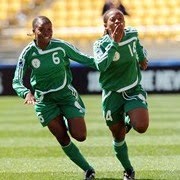
On 30 October 2008, Nigerian midfielder Soo Adekwagh got her team off to a blazing start against South Korea in the 2008 U-17 Women's World Cup by scoring after only 22 seconds.

Hosted by New Zealand, the 2008 tournament was the first FIFA-sponsored U-17 women's world championship. The tournament started two days earlier, but Nigeria and South Korea met on the first match day for Group D, which also included England and Brazil.

Playing before a crowd of 11,500 at Wellington Stadium, Nigeria kicked off. Adekwagh (pictured, right) received the ball and fired a dipping shot toward goal. The ball surprised Korea's keeper, Lee Hyo Ju, who was unable to prevent it from going into the net. At 22 seconds, the goal bettered the previous record of 30 seconds, set by Sweden's Lena Videkull in 1991, as the fastest goal in FIFA women's history.

Nigeria proceeded to win the match 2-1, but were eliminated in the group stage after a loss to England and a draw with Brazil. South Korea rallied to win the group, but were themselves ousted by the United States in the first knockout round.

Adekwagh currently plays for Bayelsa Queens, one of Nigeria's most successful women's clubs, and was a member of the Nigerian team that advanced to the Final of the 2010 U-20 Women's World Cup.

Sunday, July 4, 2010

5 July 1994 - It's In The Baggio

On 5 July 1994, Italy staged a dramatic extra-time comeback win against Nigeria in the World Cup Round of 16, despite being down to 10 men. The hero of the day was forward Roberto Baggio (pictured), who would make headlines of a different kind later in the tournament.

Italy had been largely unimpressive in the group stage, finishing third in their group behind Mexico and Ireland. But the rules at the time allowed the top four third-place teams to advance and Italy - in fourth place - just made it. Nigeria, on the other had, won their group over Bulgaria, Argentina, and Greece.

Played before a crowd of 54,367 at Foxboro Stadium outside of Boston, the Round of 16 match appeared to going Nigeria's way, as winger Emmanuel Amuneke scored off a 25th minute corner kick that was poorly defended by Italy. The Azzurri's attack looked anemic for most of the match and Italy's fate appeared to be sealed by the ejection of midfielder Gianfranco Zola. Zola, playing in his one and only World Cup match, was sent off for elbowing Nigeria's Augustine Eguavoen, though replays suggested that the red card was not warranted.

The ejection spurred the Italians to action and, in the 88th minute, Baggio found the equalizer with a low driving shot from the top of the box. In extra time, Eguavoen conceded a penalty, bringing Italian defender Antonio Bennarivo down just outside Nigeria's 6-yard box. Baggio stepped up and converted the kick, sending the ball in off the left post for the win.

Italy eventually advanced to the Final where they lost to Brazil on penalties, with Baggio famously missing the Italians' last kick.

Monday, April 26, 2010

27 April 1993 - The Zambian Air Disaster

On 27 April 1993, a plane carrying the Zambian national team crashed into the Atlantic Ocean, killing everyone on board.

The plane, a military DHC-5 Buffalo, was carrying the team to Senegal for a World Cup qualifying match and had just stopped in Libreville, Gabon to refuel. Shortly after take-off, it lost power and crashed into the water.

The crash killed all thirty passengers, including 18 members of the Zambia national team, their manager and support staff. The only team member not killed in the crash was their captain, Kalusha Bwalya, who was in the Netherlands playing for PSV Eindhoven and had made separate flight arrangements to get to Senegal.

The Football Association of Zambia chose to continue its efforts to qualify for the 1994 World Cup and quickly formed a new squad around Bwalya. They fell one point short of qualification, however, losing 1-0 to Morocco in the final match when a draw would have put them through.

The new team found success the following year, advancing to the 1994 African Nations Cup Final against Nigeria. They took an early lead in the 3rd minute and, though they eventually lost 2-1, returned home as national heroes.

Tuesday, February 2, 2010

3 February 2008 - Going To Agogo

On 3 February 2008, hosts Ghana defeated neighboring rivals Nigeria in the quarterfinals of the 2008 African Cup of Nations. The 2-1 win for the Black Stars avenged losses to Nigeria in two of the previous three tournaments.

Playing in Accra's Ohene Djan Stadium before a crowd of 45,000, Nigeria's Super Eagles took a first-half advantage when striker Yakubu Ayegbeni converted a 35th-minute penalty kick. The score momentarily silenced the home crowd, but they soon regained their voice and exploded with joy when Ghana midfielder Michael Essien equalized in the second minute of first-half injury time.

Ghana carried the momentum into the second half and continued to press, despite the sending off of their captain, John Mensah. In the 88th minute, striker Junior Agogo (pictured) netted the match-winner, sending the Black Stars through to the next round.

Perhaps drained from their emotional win over Nigeria, the Black Stars were unable to find the net in their next match, a 1-0 loss to Cameroon, but did not go home empty-handed, beating the Ivory Coast 4-2 in the third-place match.

View highlights of the match here.

Sunday, August 2, 2009

3 August 1996 - The Super Eagles Have Landed

On 3 August 1996, Nigeria beat Argentina 3-2 in the gold medal match of the Summer Olympics before a crowd of 86,117 in Athens, Georgia's Sanford Stadium.

The Nigerian side, nicknamed the Super Eagles, had impressed during their first World Cup appearance two years earler, when they won their group, then lost in the first knockout round to eventual runners-up Italy in extra time. They had also won the African Cup of Nations in 1994.

In the 1996 Olympics, they finished the group stage even on points with Brazil and Japan, with two wins and one loss each, but finished in second position on goal differential (Brazil finished first). They then defeated Mexico 2-0 in the quarterfinals before beating Brazil 4-3 in the semifinals with a dramatic come-from-behind victory. With Brazil up 3-2, striker Nwankwo Kanu scored a 90th minute equalizer to force extra time, then won the game with a golden goal in the 94th minute.

Nigeria received more last-minute heroics in the Final. After giving up a 3rd-minute goal, then twice drawing level, the match was tied at 2-2 in the 90th minute when midfielder Emmanuel Amuneke received the ball about 10 yards out from the Argentine goal and sent a soft looping shot over the head of keeper Pablo Cavallero for the win.