On 22 March 1866, Nottingham Forest and Notts County played each other for the first time in a match that also happened to be Forest's first official game.
Forest were originally organized to play shinty, a stick-based game similar to hockey. But in 1865, J. S. Scrimshaw proposed that the club switch to football. The players met at the Clinton Arms on Shakespeare Street and voted in favor of the switch.
The following year, for their first official match, they scheduled a friendly with fellow Trentside club Notts County. Although Notts County were the more experienced club, having been founded in 1962, that experience did not translate into an advantage and the match ended as a scoreless draw.
Since then, the two teams have played a total of 94 times in the league, FA Cup, and League Cup, resulting in 40 wins for Forest, 30 for Notts County, and 24 draws.
On 11 February 1981, Nacional edged Nottingham Forest in the Toyota Cup to claim a 1-0 win.
Established in 1960, the Toyota Cup/Intercontinental Cup paired the reigning Copa Libertadores champions against the current European Cup winners. Originally played as a home-and-away two-legged tie, the 1980 edition (played in February 1981) was the first to decide the winner with a single match and the first to be played at the neutral location of Tokyo's National Stadium.
Forest entered the match on an unbeaten run of 42 matches and had collected international honors at a rapid pace, winning the 1979 and 1980 European Cups as well as the 1979 UEFA Super Cup. Nacional, meanwhile, had won the 1979 Uruguay Primera División along with that year's Copa Libertadores.
Playing before a crowd of 62,000, Nacional took an early lead with a 10th-minute goal from forward Waldemar Victorino (pictured at right). The attack was started near the midfield line by right back José Hermes Moreira, who passed the ball, then charged down the right side, got the ball back, and sent in a cross. Victorino received it in front of the goal, avoided a tackled, then drove the ball into the roof of the net.
It was Nacional's only real chance of the match, but it was enough. Nottingham Forest came close a couple of times, once sending the ball just wide of goal and then heading it off the post, but could not crack the Nacional defense. The day ended 1-0, with Victorino as the man of the match.
On 10 August 1971, future Manchester United and Republic of Ireland captain Roy Keane was born in Cork. A tenacious central midfielder, he was known for his competitive spirit both on and off the pitch.
He began his career with Cobh Ramblers (1989-90) and Nottingham Forest (1990-93), but spent the majority of his career at Manchester United where he played from 1993 to 2005. United paid a then-record British transfer fee of £3.75 million to sign him from Forest and Keane delivered instantly, scoring a brace in his Old Trafford debut, a 3-0 victory over Sheffield United. That first season, United went on their first league and FA Cup double.
He would go on to win seven league titles, four FA Cups, and the Champions League with United, but his success on the pitch was often overshadowed by his temper, with Keane receiving a total of 11 red cards during his time with United, often for violent conduct. In a 2001 match against Manchester City, Keane was ejected for brutally tackling Alf-Inge Haaland. He later revealed in his autobiography that the challenge had been an intentional retaliation for a dust-up the two had had in a previous match. The admission resulted in a further 5-match ban and a fine of £150,000.
Keane left United in 2005 after several public disagreements with his teammates and manager Alex Ferguson. He moved to Celtic, but made only 13 appearances for them before retiring in 2006.
He turned to management later that year and has helmed Sunderland (2006-08) and Ipswich Town (2009-11). Although he was sacked from Ipswich in January 2011, he still lives nearby with his wife and five kids.
On 12 April 1992, Manchester United defeated Nottingham Forest in the League Cup Final. It was the first League Cup for the club and the first piece of silverware for Ryan Giggs, who later became the most decorated British player in history.
It was United's second consecutive appearance in the Final after losing to Sheffield Wednesday the year before. Forest, meanwhile, had won it in 1990, the last of four League Cups won by the club under manager Brian Clough.
Played before a crowd of almost 77,000 at Wembley Stadium, it was closely-fought affair, with Giggs (pictured) providing the assist for the day's only goal, scored in the 14th minute by United forward Brian McClair. It was only the third domestic trophy for manager Alex Ferguson, after the 1990 FA Cup and the 1990 FA Charity Shield (the latter shared with Liverpool), but he had also won the Cup Winners' Cup and the UEFA Super Cup in 1991. He and Giggs would go on to win a multitude of additional silverware with United, including 11 league titles, 4 more FA Cups, 3 more League Cups, and 2 Champions League trophies. Two of Forest's starting XI that day, Roy Keane and Teddy Sheringham, would themselves later win trophies with United as well.
It was the last cup final for Clough, who had already won 2 league titles and 2 European Cups. He retired in 1993.
On 9 February 2010, Amy Fearn became the first woman to referee an English Football League match when she took charge of the last 20 minutes of Coventry City's contest against Nottingham Forest.
Despite the recent controversy that saw Sky Sports analysts Andy Gray and Richard Keys lose their jobs after making sexist remarks against Premier League assistant referee Sian Massey, England's Football League has used female officials since 1991, when Wendy Toms served as a reserve official for a Third Division match. Toms later worked as an assistant referee in both the Football League and the Premier League, and also refereed matches in the non-League Football Conference starting in 1996.
But no woman had ever been the primary official in England's top four divisions until Fearn. A financial analyst for Rolls Royce who has worked as an official since she was 14, Fearn had worked League matches as a referee's assistant since 2006. And she was again filling that role for the Coventry-Forest match when, with 20 minutes left, the match's originally-assigned referee, Tony Bates, left the pitch with a leg injury. Fearn then took the whistle and her place in history.
The match ended as a 1-0 win for Coventry. Although Fearn heard a few taunts, she shrugged them off, saying afterward "I just laugh and take it with a pinch of salt." Coventry striker Clinton Morrison praised Fearn, saying "There was no dissent when she was in charge and no bad language. It would have been interesting if there had been any controversy but there wasn’t because she did a very good job. There is only one thing that matters about the person in charge and that is how good a referee they are."
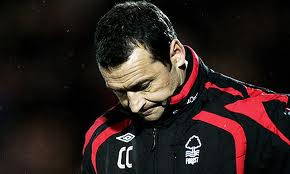
On 1 January 2008, Nottingham Forest hosted Huddersfield Town in a League One match that delivered controversy before the opening whistle.
Several clubs across the UK started their matches that day with a moment of silence for Motherwell captain Phil O'Donnell, who collapsed during a match three days earlier and died. Forest manager Colin Calderwood, a former teammate of O'Donnell's, elected not to join them, however, saying "The fact that it was a boy in Scotland, does that make it any different to a boy in Colombia?"
Forest proceeded to win the match, 2-1, and subsequently earned promotion to the Championship for the 2008-09 season.
Calderwood later had cause to regret his comments. In October 2010, he became manager of Hibernian less than a month before Motherwell were scheduled to visit. Before that match, played on 13 November, the Motherwell supporters demanded an apology from Calderwood. He duly obliged, saying "It's something that has caused offense and for that I can only apologize."
On 30 May 1979, Nottingham Forest won their first European trophy, beating Malmö FF in the European Cup Final before a crowd of 57,000 at the Olympiastadion in Munich. It was an incredible accomplishment for Forest, who became only the third English side - after Manchester United and Liverpool - to claim Europe's biggest prize.
Forest were riding a wave of success under manager Brian Clough, who had taken Derby County to the European Cup semifinals six years earlier. After leaving Derby and suffering through a brief spell at Leeds, Clough moved to Forest in January 1975. Though they were in the Second Division at the time, Clough steered them to promotion in 1977, then to the League title in 1978.
In the European Cup, Forest advanced with wins over Liverpool, AEK Athens, Grasshopper, and Köln. Malmö, who were also playing in their first European Cup Final, reached it by beating Monaco, Dynamo Kiev, Wisła Kraków, and Austria Vienna.
Despite the participation of two relative Cinderella teams, the match itself was anticlimactic. Malmö, dealing with the loss of key players to injury, played a defensive game to slow the English attack. But Forest secured the match's only goal near the end of the first half, as their £1 million signing Trevor Francis - making his first European appearance for Forest - scored a 45th-minute header (pictured) that turned out to be the matchwinner.
Forest successfully defended their title the next season, beating Hamburg 1-0.
On 9 February 1979, Nottingham Forest manager Brian Clough introduced the press to his newest signing, English striker Trevor Francis--the first player in England to break the £1 million barrier. Clough added to the spectacle by showing up at the press conference in a bright red leather jacket with his squash racket in hand.
When Clough signed Francis from Birmingham City, he was careful to set the transfer fee at £999,999 in order to prevent the "million pound" mark from going to the striker's head. But taxes pushed the total fee over £1.1 million, more than doubling the previous record of £495,000, paid by Manchester United to Middlesbrough for defender Gordon McQueen in February 1978.
With Francis in the side, Forest lost only one league match for the remainder of the season, finishing second in the Division One table, and won the League Cup. The crown jewel in their season, however, was their 1-0 win over over Swedish side Malmö in the 1979 European Cup Final, with Francis heading in the winning goal.
That proved to be the highlight of Francis' career. Injuries hampered his time at Forest, preventing him from playing in their win in the 1980 European Cup Final, and he moved to Manchester City in 1981 for £1.2 million.
On 11 December 1886, Dial Square FC played its first match, defeating Eastern Wanderers 6-0. The match was played in an open field in London's Isle of Dogs.
Dial Square were founded earlier that year by a group of workers from the Dial Square workshop at the Royal Arsenal, located at Woolwich in southeast London. The club's founding members included Scotsman David Danskin (who captained the side for the match against Eastern Wanderers and had also purchased the club's first football) and Englishmen Jack Humble, Fred Beardsley, and Morris Bates.
The club played in red shirts obtained from Nottingham Forest. Both Beardsley and Bates had previously played for Forest and convinced their former club to donate the shirts.
On Christmas Day 1886, Dial Square changed their name to Royal Arsenal, then changed it again in 1891 to Woolwich Arsenal. In 1913, they moved to Highbury in north London and changed their name once more, this time dropping the "Woolwich" to be known simply as Arsenal. They have since become one of the most successful clubs in football, winning 13 top flight titles and 10 FA Cups.
On 28 October 1998, 17-year old center back John Terry made his first appearance for Chelsea's senior team, coming on as a second-half substitute in a League Cup match against Aston Villa. Chelsea won 4-1.
Terry was born in London on 7 December 1980 and played for the Chelsea youth team from 1995 to 1998. He signed his professional contract with the Blues for the 1998-99 season, making 6 appearances.
In 2004, new manager Jose Mourinho handed the captain's armband to Terry, who rewarded the decision by leading Chelsea to back to back league titles in 2005 and 2006.
Apart from a brief loan spell with Nottingham Forest in the 1999-2000 season, Terry has spent his entire club career with Chelsea. Through the 2008-09 season, he had made 404 appearances for the London club. In addition to the league titles, he has won three FA Cups (2000, 2007, 2009), two League Cups (2005, 2007), and two Community Shields (2005, 2009).
Despite his successes, however, he is famous for the 2008 UEFA Champions League Final in which he slipped and missed the penalty that would have won the trophy.
On 20 July 1974, controversial manager Brian Clough was named manager of Leeds United. He was dismissed from the post on 12 September 1974, after only 44 days in charge.
A star striker for Middlesbrough (1955-61) and Sunderland (1961-64), Clough's playing career was cut short by a knee injury. He turned to management and, in 1965, took over at Hartlepools United. He was then just 30 years old, making him the youngest manager in the League at that time.
In May 1967, Clough took over at Derby County, then languishing in the Second Division. Clough, along with assistant manager Peter Taylor, reversed Derby's fortunes and led them to the First Division title at the end of the 1971-72 season. Clough and Taylor soon fell out with Derby's Board of Directors over issues including transfer fees and Clough's propensity for making controversial statements (such as his criticism of the Derby supporters as "a disgraceful lot"), and the pair resigned in October 1973.
After a brief and unsuccessful spell at Brighton & Hove Albion during the 1973-74 season, Clough took the reins at Leeds, who were coming off their own First Division title. Taylor remained at Brighton.
Clough's move to Leeds raised more than a few eyebrows, as, during his time at Derby, he had been especially critical of Leeds and their previous manager, Don Revie. In particular, he had accused Revie's Leeds side of playing dirty and suggested that the club should be relegated and Revie himself fined.
Despite his appointment as manager, Clough reportedly remained vociferously critical of Revie and Leeds' prior tactics, which alienated him from many of the team's best players, including the midfield pair of Irish international Johnny Giles and Scottish international Billy Bremner. Clough's Leeds side won only one match and drew two from its first six, after which he was promptly sacked.
Clough cemented his status as a coaching legend, however, after moving to Nottingham Forest in 1975. At that time, Forest was a mid-table Second Division side, but Clough and Taylor (who joined Forest from Brighton in 1976) led them to promotion in 1977 and the Division One title in 1978. At Forest, Clough also achieved his crowning glory, winning back-to-back European Cup titles in 1979 and 1980.
Clough retired in 1993 and died in 2004. In 2006, author David Peace published a fictionalized account of Clough's time at Leeds, titled The Damned Utd. Critics generally praised the book, but Clough's family and former players—including Giles—claimed Peace's portrayals of events was inaccurate and painted Clough in an unfairly negative light. A film version of the book was released in 2009, starring Michael Sheen as Clough.
On 24 April 1988, Luton Town F.C. staged a dramatic upset victory over heavily-favored Arsenal in the 1988 League Cup Final, claiming the club's first major trophy.
Playing at Wembley Stadium before a crowd of 95,732, the Hatters shocked the defending champions by taking an early lead with a goal from forward Brian Stein in the 13th minute. In the second half, however, Arsenal rallied. Gunners striker Alan Smith brought them level in the 71st minute, then winger Martin Hayes scored three minutes later to give Arsenal a 2-1 lead.
The match appeared to be a certain victory for Arsenal when, in the 85th minute, the Gunners were awarded a penalty. Luton keeper Andy Dibble saved Nigel Winterburn's spot kick, however, and the Hatters regained their early momentum. In the 82nd minute, after a faulty clearance from Arsenal defender Gus Caesar near the edge of his penalty area, Stein crossed the ball in for Luton midfielder Danny Wilson, who headed home the equalizer.
With seconds left in regulation, and extra time looming, Arsenal defender and captain Tony Adams fouled Luton substitute Mark Stein. Brian Stein then scored his second goal of the match from the ensuing free kick, and Luton were League Cup champions. The trophy itself was broken during the post-match celebrations.
The Hatters returned to the League Cup Final in 1989, but lost to Nottingham Forest. In 1992, they were relegated from the top flight. Luton's fortunes continued to sour, leading to subsequent relegations and administration. On 13 April 2009, by then in League Two, Luton drew with Chesterfield, confirming that they would finish the season in the relegation zone and drop out of the Football League for the 2009-10 season.
On 15 April 1989, 94 Liverpool supporters died at Hillsborough Stadium in Sheffield, England during an FA Cup semi-final match between Liverpool F.C. and Nottingham Forest F.C. Two people died later as a result of injuries sustained that day, raising the total number of fatalities to 96. A total of 766 fans were injured.
The stadium - like many around the world at the time - had standing room only areas called terraces, which were sectioned off into a number of fenced pens.
A number of fans showed up late to the match, having been held up by unscheduled roadworks. Large crowds formed at the entrances as the match started and the police, in order to ease the congestion and avoid injuries, opened two side gates into the central pens for the Liverpool supporters. The police failed to monitor the number of supporters in the central pens, however, so that the ensuing rush of supporters filled them far beyond capacity.
The people in the front were forced up against the fencing between the terraces and the pitch, crushed by the weight of the crowd behind them. Because of an absence of stewards or police to direct the crowd, the entering supporters did not know what was happening at the front and continued to press their way in to see the match. The pressure of the crowd was so great that many of the 96 casualties died while standing up.
The British government appointed Lord Justice Taylor to investigate the circumstances leading to the disaster. His conclusion, known as the Taylor Report, led to the elimination of fencing between the supporters and the pitch and the conversion of many of the larger stadiums in Britain to all-seaters.
To this day, the incident at Hillsborough is the deadliest stadium-related disaster in British history.
 On 22 March 1866, Nottingham Forest and Notts County played each other for the first time in a match that also happened to be Forest's first official game.