Showing posts with label United States. Show all posts

Sunday, March 18, 2012

19 March 1924 - The Mighty Joe Gaetjens

On 19 March 1924, Joe Gaetjens, who scored one of the most memorable goals in the history of the United States national team, was born in Port-au-Prince, Haiti.

Born to a prominent family--one great-grandfather was sent to Haiti on a mission by the king of Prussia and another was a general involved in Haiti's fight for independence--Gaetjens started his career with L'Etoile Hatienne, where he won championships in 1942 and 1944. But in 1947, the then-23-year old forward moved to New York to study accounting at Columbia University.

While there, he continued to play football for American Soccer League club Brookhattan, owned by Eugene Diaz, and supplemented his pay by washing dishes at Diaz's Harlem cafe. Gaetjens was the ASL's top scorer in 1950, which led to his inclusion on the US roster for the 1950 World Cup in Brazil. (He was eligible under the rules at the time, which required only that players had signed a paper expressing their intent to apply for citizenship, which Gaetjens had done.) There, after an opening 3-1 loss to Spain, Gaetjens scored with a diving header to beat England 1-0, one of the greatest upsets in World Cup history.

Afterward, he played briefly in France, including a short spell with Racing Club de Paris, then returned to Haiti and made a solitary appearance for the Haitian national team in 1953. He started a dry cleaning business and coached youth football until 1964, when, due to political activities of his younger brothers, he was imprisoned upon the orders of Haitian president François "Papa Doc" Duvalier. He was never seen in public again and his death remains a subject of speculation.

[For more on Gaetjens' life, read Chasing Gaetjens by Leander Schaerlaeckens.]

Wednesday, January 18, 2012

19 January 2008 - Donovan Takes The Lead

On 19 January 2008, a penalty kick against Sweden made Landon Donovan the all-time scoring leader for the US men's team.

Since making his first appearance in 2000, the forward/midfielder had already become the team's all-time leader in assists, passing Cobi Jones for that honor in 2006. By January 2008, he had scored a total of 34 goals, including key strikes in the 2002 World Cup and several Gold Cup competitions, to match the record set by Eric Wynalda from 1990 to 2000.

Playing a friendly against Sweden at the Home Depot Center in California, the US went up 1-0 with a 15th-minute goal from debutant Eddie Robinson. Then, just after the break, Swedish center back Mattias Bjärsmyr committed a foul in the box against US forward Jozy Altidore. Donovan stepped up and converted the ensuing penalty kick to claim sole possession of the goalscoring record. The US went on to win the match 2-0.

Donovan has continued to add to his total and currently has extended the record to 46. It remain well behind the record for the women's team, however, set at 158 by Mia Hamm from 1987 to 2004.

(Photo credit to Kirby Lee, US Presswire.)

Thursday, January 12, 2012

13 January 1988 - Statistically, It Proved To Be A Little Misleading

On 13 January 1988, the United States beat Guatemala with a goal from left back Jeff Agoos, making only his second national team appearance.

The teams met in Guatemala City, where the United States had lost all four of their previous matches. The most recent loss had come just three days earlier when the hosts won 1-0. That match marked the international debut for Agoos (pictured), a star in the making at the University of Virginia. His performance on that day was unremarkable, however, and he was substituted for fellow dubutant John Diffley.

US manager Lothar Osiander included both Agoos and Diffley in the starting line-up for the rematch on 13 January, with Agoos providing the day's only goal to give the US a narrow victory in the friendly. And it turned out to be a very rare occurrence. Agoos went on to earn a total of 134 caps for the US--enough to place him third on their all-time appearances list--but he scored only three more times for them.

Sunday, December 4, 2011

5 December 2009 - Clearly, They Didn't Believe In Cover Jinxes

On 5 December 2009, the Sun celebrated England's draw for the 2010 World Cup by using their opponents' names to form the word "EASY" on their cover. It turned out to be a little more difficult than they thought, however.

The draw, which had taken place the previous day in South Africa, placed England in a group with the United States, Algeria, and Slovenia. Calling it "the best English group since the Beatles," the Sun headline touted the draw as "England, Algeria, Slovenia, Yanks." Several commentators agreed, with former English international Jack Charlton going so far to say "I think it is probably the easiest of the World Cup groups."

It turned out to be anything but, as England struggled to draws with the United States and Algeria in their two opening matches. Going into the group's last match day, they were level on points with the United States and needed a result against leaders Slovenia to ensure their progress into the next round.

As it turned out, they advanced with a 1-0 win over Slovenia, but did so as the group's second place team after the US topped the group by defeating Algeria. The relief was short-lived, however, as both England and the US were knocked out in the next round with losses to Germany and Ghana, respectively.

Sunday, November 27, 2011

28 November 1885 - The First International International

On 28 November 1885, the United States hosted Canada in the first international match to be played outside the United Kingdom. Canada won, 0-1.

The match, played in New Jersey, predated the formation of both the Canadian and American football federations. Instead, Canada's Western Football Association arranged the contest with the unofficial governing body of US football, the American Football Association. As a result, both countries consider it an unofficial international.

According to the match report in the New York Times, the match was "played according to the American Association rules," but they conferred no advantage to the hosts, who went down 0-1 in the tenth minute. After that goal, a correspondent for the Globe of Toronto said "the balance of the game was simply an exhibition of reckless kicking and rough and tumble play." A fistfight broke out between a couple of players.

Canada's goalkeeper, J. N. McKendrick, was outstanding and repeatedly denied the Americans' attempts on goal as the match ended as a Canadian victory.

The match was such a success that a repeat was scheduled the following year on the same pitch, with the US winning 3-2.

(For more details on the match, visit Richard Whittal's excellent blog, A More Splendid Life.)

Saturday, August 20, 2011

21 August 2008 - Carli Lloyd's Gold-Medal Goal

On 21 August 2008, the United States women won their third Olympic gold medal, beating Brazil in extra time.


It was the fourth straight appearance in the gold medal match for the US, who had won it twice before, including a 2-1 extra time win over Brazil in 2004. The two teams had developed a healthy rivalry, intensified by Brazil's 4-0 drubbing of the US in the 2007 World Cup that cost manager Greg Ryan his job. The 2008 Olympics were the first major tournament for his successor, Pia Sundhage.


Played before a crowd of 51,612 at the Workers Stadium in Beijing, the final was a fluid, attacking affair that nonetheless failed to produce a goal in the first 90 minutes. The best chance of the day fell to Brazilian star Marta in the 72nd minute when she slipped through the US defense and fired from point-blank range. But goalkeeper Hope Solo managed to get a hand on the ball and stopped the shot.


Then, in the 96th minute, a charging Carli Lloyd (pictured) passed the ball to Amy Rodriguez, who quickly returned the ball. Lloyd drove a shot in from just outside the box, crossing the face of the goal and beating Brazil's keeper, Barbara.


Brazil pressed hard for an equalizer, with both Marta and Cristiane creating chances, but the US defense held firm to preserve the 1-0 victory.


Monday, July 25, 2011

26 July 2003 - Convey's First Was Good Enough For Third

On 26 July 2003, winger Bobby Convey scored his first and only international goal to lift the United States over Costa Rica in the CONCACAF Gold Cup's third-place match.

Although he was only 20 years old at the time, Convey had already developed a resume full of potential. He joined DC United in 2000, making him the youngest signing in MLS, then earned his first full international cap that same year. By the time he played against Costa Rica in the Gold Cup, he was captain of the U20s and had played in all but one of the senior side's matches that year.

The US had advanced to the semifinals in the tournament, but lost to Brazil 2-1 in extra time. That put them into the third-place match against Costa Rica, who had been eliminated by Mexico. Playing at the Orange Bowl in Miami, Costa Rica took a 2-1 first-half lead with a brace from striker Rolando Fonseca (24', 39') sandwiched around a goal from US defender Carlos Bocanegra (29').

But the Yanks rallied in the second half, drawing level with a 56th-minute strike from midfielder Earnie Stewart, then taking the lead 11 minutes later. The match-winner started with Landon Donovan, who split the defense with a perfect ball. Convey latched on to it and fired it home with a left-footed blast from the edge of the penalty area.

Convey went on to earn a total of 46 caps between 2000 and 2008, but never scored another international goal.

Wednesday, July 20, 2011

21 July 1998 - Iran All Over The US

On 21 July 1998, Iran secured their first-ever World Cup victory, beating the United States in the group stage, 1-2.

1998 marked Iran's return to the tournament after a 20-year absence (they had previously qualified for the World Cup in 1978, but exited in the first round after two losses sandwiched around a 1-1 draw with Scotland) and they opened their campaign with a narrow 1-0 loss to Yugoslavia.

Their second match was against the United States and drew worldwide attention due to the heated political relations between the two countries following the Iranian revolution of 1979. Anti-American sentiments in Iran grew to fiery heights in the 1980s, particularly after the US launched a military strike against Iran in 1988. In 1990, then-President Clinton issued an Iranian embargo.

Playing before a crowd of almost 40,000 in Lyon, the two teams tried to minimize any political relevance for the match, exchanging gifts and posing for a group photo prior to kick-off. In Iran, however, the match was celebrated as much for the opponent as for the result--Iran won convincingly after getting goals from midfielder Hamid Estili (40') and winger Mehdi Mahdavikia (84'). Striker Brian McBride scored a consolation goal for the Americans in the 87th minute to end the match as a 1-2 win for Iran.

Both teams went on to lose their remaining matches and were eliminated in the group stage.

Monday, July 18, 2011

18 June 2010 - The Comeback Kids Strike Again

On 18 June 2010, the United States scored twice in the second half to salvage a 2-2 draw after falling behind to Slovenia in the group stage of the World Cup.

The US had already rescued a point in their first match, equalizing against England to earn a 1-1 draw, while Slovenia claimed the group's top spot with a win over Algeria. The Slovenians looked certain to hold on to their position when they took a 2-0 lead in the first half with goals from winger Valter Birsa (13') and forward Zlatan Ljubijankič (42').

But, as they had in the first match, the US displayed a combination of determination and resilience. They came out firing in the second half and were rewarded when Landon Donovan surged into the Slovenian box in the 48th minute and blasted the ball into the roof of the net from close range to close the gap to 2-1. The US continued to press for an equalizer and found it in the 82nd minute when a header from forward Jozy Altidore dropped for midfielder Michael Bradley, who then chipped it over the Slovenian keeper.

As improbable as the comeback had been, the US came close to winning it a few minutes later when substitute midfielder Maurice Edu put the ball in the back of the net. But the referee disallowed the goal for reasons that remain unexplained. Still, the point for the draw proved critical for the US, who were tied England on points at the end of the first round, but won the group by virtue of goals scored.

Friday, July 15, 2011

16 July 2008 - A Bad Break For Wambach

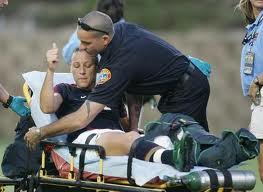
On 16 July 2008, the United States women beat Brazil in a pre-Olympics friendly, but lost Abby Wambach, their leading scorer, who suffered a broken leg.

Played before a sold-out crowd of 7,502 at San Diego's Torero Stadium, the match was the second contest between the two teams in four days and the last for both teams before they headed to China for the Olympics. The US had won the earlier match 1-0 and were hoping for a repeat performance.

Those hopes took a blow in the 31st minute when Wambach--the leading scorer for the US that year with 13 goals and 99 goals in her international career--collided with Brazilian defender Andreia Rosa and immediately waved for the medical staff. She was taken straight to the hospital where x-rays confirmed fractures in her tibia and fibula. Despite the loss of Wambach, the Americans continued to press Brazil and were rewarded with an 85th-minute goal from substitute Natasha Kai for the 1-0 win.

Brazil and the US met again in the gold medal match in Beijing where the US won again by the score of 1-0. Wambach missed the tournament, but returned to the US team in May 2009 and scored her 100th goal in July of that year. Her tally currently stands at 121 after scoring critical goals against Brazil and France in the knockout stages of the 2011 Women's World Cup.

Wednesday, July 6, 2011

7 July 1991 - The Yanks Grab The Gold

On 7 July 1991, the United States won the inaugural CONCACAF Gold Cup, beating Honduras on penalties, 0-0 (4-3).

Played in the Californian cities of Pasadena and Los Angeles, the 1991 Gold Cup included eight teams from North and Central America. As hosts, the US qualified automatically, while Honduras earned their place as runners-up to Costa Rica in the Central American qualifying tournament, the UNCAF Nations Cup.

The teams were split into two groups of four. In Group A, Honduras dropped only a single point thanks to a 1-1 draw with Mexico, but topped the group on goal differential. They then advanced to the final with a win over Costa Rica. Meanwhile, the US won Group B with victories in all three matches, then beat Mexico 2-0 in the semifinal.

The final was played before a crowd of 39,873 at Memorial Coliseum in Los Angeles. There, the two teams battled to a scoreless stalemate at the end of extra time to send the match into a penalty shootout. Honduras went into the shootout with their reserve goalkeeper, Wilmer Cruz, who had replaced their starting keeper, Belarmino Rivera, in the 119th minute.

After five kicks each, the teams were level at 2-2, so they moved into sudden death. After seven kicks each, they were still level, with each side having made one and missed one of their intervening kicks. US defender Fernando Clavijo then converted the next attempt--the Americans' eighth--to take the lead. Juan Carlos Espinoza stepped up for Honduras, but rifled his shot over the bar as the US claimed the victory.

It was the first major trophy for the US, who have since won the tournament a total of four times. Honduras, who won the CONCACAF Championship in 1981, have yet to return to the Gold Cup Final.

Wednesday, June 22, 2011

23 June 2010 - The Yanks Aren't Dead Yet

On 23 June 2010, Landon Donovan's 91st-minute goal saved the United States from a first-round elimination and won them the top spot in their World Cup group.

The US had opened the tournament with a 1-1 draw against England, followed by a 2-2 draw with Slovenia. In both matches, the Yanks had surrendered early leads and had to claw their way back to earn a point. Against England, they went down 1-0 to a 4th-minute goal from Steven Gerrard before Clint Dempsey's speculative shot in the 40th minute slipped through the hands of keeper Rob Green to level the sides. Against Slovenia, the US were down 2-0 at the break before goals from Donovan (48') and Michael Bradley (82') earned them the draw. They appeared to get a late winner when Maurice Edu struck the ball home off of a Donovan free kick, but the referee disallowed the goal.

Against Algeria in the group's last match, the US managed to avoid giving up an early goal, but struggled to find one of their own. Playing before a crowd of 35,827 at Pretoria's Loftus Versfeld Stadium, the teams battled to a scoreless draw for 90 minutes. Had that result stood, both the US and Algeria would have been eliminated.

But in the first minute of stoppage time, US keeper Tim Howard threw the ball upfield to Donovan, who raced forward and passed it to forward Jozy Altidore in the Algerian box. Altidore crossed the ball in for Dempsey, but the Algerian keeper, Raïs M'Bolhi, beat Dempsey to the ball and batted it away. It fell at the feet of a surging Donovan, who fired it home for the win.

In the Round of 16, the US again fell victim to an early goal and were eliminated by Ghana, 1-2 (aet).

Monday, June 13, 2011

14 June 2009 - Spain's Better-Than-Magical Moment

On 14 June 2009, Spain beat New Zealand for their 33rd consecutive unbeaten match, surpassing the previous record of 32 set by the Magical Magyars of Hungary.

Hungary's streak ran from June 1950 to June 1954 and included the 1952 Olympic gold medal and a trip to the 1954 World Cup Final. After losing 0-1 to Romania in Cadiz on 15 November 2006, Spain started their unbeaten run on 2 February 2007, beating England in a friendly played in Manchester, 0-1. Their streak carried them through qualification for Euro 2008, then through the tournament itself, which they won by beating Germany in the Final. That was their 22nd unbeaten match.

The record-breaking match came in the FIFA Confederations Cup, played in Rustenburg, South Africa. Spain got goals from Fernando Torres (pictured) (6', 14', 17'), Cesc Fabregas (24'), and David Villa (48') en route to a comfortable 0-5 victory. It was their second biggest scoreline during the streak, coming after a 6-0 win over Azerbaijan in a friendly five days earlier.

Spain followed their record victory with wins over Iraq (1-0) and South Africa (2-0) to stretch their unbeaten run to 35 consecutive matches before it ended in the semifinals with a 2-0 loss to the United States.

Friday, May 13, 2011

13 May 1982 - Gooch Is Loose

On 13 May 1982, US international and FC Twente center back Oguchi “Gooch” Onyewu was born in Washington, DC.

Onyewu played for years at Clemson University (2000-01), then signed with French side Metz in 2002. He made only three appearances for Metz, however, before moving to Belgian club La Louvière on loan. In 2004, he moved again, signing with Standard Liège. He flourished there, twice being named to the Belgian league’s Best XI and winning the Foreign Player of the Year in 2005. He won back-to-back league titles with Standard in 2008 and 2009 before making a shock move to AC Milan for the 2009-10 season.

A knee injury forced him to miss the entire Serie A season, however, and in 2011 Milan sent him on loan to defending Eredivisie champions FC Twente, where he has helped them hold on to the top spot.

Onyewu has played for the United States since 2004, winning the 2005 and 2007 CONCACAF Gold Cups.

Wednesday, April 13, 2011

14 April 1998 - So, About That "Captain For Life" Thing ...

On 14 April 1998, manager Steve Sampson dropped captain John Harkes from the US World Cup squad in a decision that would not be fully explained for almost 12 years.

Harkes first joined the national team in 1987 while still a student at the University of Virginia. He quickly secured a regular starting position in the midfield and helped the US qualify for the 1990 World Cup--their first since 1950--and played every minute for the US in the tournament. He returned to the World Cup in 1994 as the US advanced out of the group stages, but missed the Round of 16 match-up against Brazil because of an accumulation of yellow cards. Brazil won 1-0.

Steve Sampson took charge of the national team in 1995 and, shortly afterward, named Harkes his "Captain for Life." But on 14 April 1998, after the US had qualified for that year's World Cup, Sampson dropped Harkes from the team, citing a variety of reasons such as reluctance to play defense, missing team flights, and ignoring curfew. Harkes denied the allegations, but claimed that, even if they were true, they did not justify his exclusion from the squad. In any event, the US finished the 1998 World Cup without a single point.

In February 2010, Sampson finally revealed the real reason for his decision, claiming that Harkes had had an affair with the wife of teammate Eric Wynalda. The revelation came in the wake of a scandal that saw England captain John Terry lose the armband over an affair with the girlfriend of teammate Wayne Bridge, with Sampson stating that "maybe people will have a little better of an understanding of what happened in the final months leading up to the World Cup."

To date, Harkes has refused to comment on the accusations.

Sunday, April 10, 2011

11 April 2006 - Meola Returns, His Ponytail Stays Home

On 11 April 2006, goalkeeper Tony Meola returned to the US national team to earn his 100th cap after a four-year break.

Meola joined the national team in June 1988. Later that summer, he replaced Los Angeles Heat keeper David Vanole as the full-time starter and manned the posts for the US in the 1990 and 1994 World Cups. He captained the side for the 1994 tournament, including their dramatic 2-1 win over Colombia. His trademark ponytail made him the face of US football, but after the tournament, he decided to try out for the NFL's New York Jets as an kicker, then briefly pursued an acting career.

He returned to the national team in 1999, but had fallen to their third-choice keeper behind Brad Friedel and Kasey Keller. Although manager Bruce Arena--who had coached Meola at the University of Virginia--selected him for the 2002 World Cup squad, Meola did not see the pitch during the tournament.

In 2006, Arena recalled Meola to the squad for a friendly against Jamaica that ended 1-1. It was his last national team appearance, but it made him the ninth player, and the only goalkeeper, to reach the 100-cap milestone for the US.

Friday, April 8, 2011

9 April 1951 - The Man From UNC

On 9 April 1951, future US National Hall of Fame coach Anson Dorrance was born in Bombay, India. He would go on to guide the UNC women's team to 20 national championships and the US national team to the 1991 Women's World Cup.

The son of an American oil executive, Dorrance spent the early part of his life abroad, including a lengthy spell in Kenya where he cultivated his love of football. While a student at the University of North Carolina, he walked onto the football team and earned all-ACC honors three times.

He took over as coach of the UNC men's team in 1977 and ran it until 1988. In the process, he won the 1987 ACC title and led UNC to that season's NCAA Final Four. His success that season resulted in the NCAA naming him their 1988 Men's Soccer Coach of the Year.

In 1979, while still coaching the men's team, Dorrance also took charge of the newly-established UNC women's team. He won his first NCAA title in his third season, with his team winning all 23 matches they played. Under Dorrance, UNC went on to win 20 NCAA titles with players such as Mia Hamm, Kristine Lilly, and April Heinrichs.

From 1986 to 1994, Dorrance also managed the US women's national team, taking them to the first Women's World Cup in 1991. Led on the pitch by Hamm and Lilly, they claimed the title by winning all six of their matches in the tournament.

Dorrance remains at UNC, who won their most recent national title in 2009.

Sunday, March 27, 2011

28 March 2010 - Reeling In The Years

On 28 March 2010, midfielder Kristine Lilly came on as a first-half substitute for the US in a friendly against Mexico. By doing so, she became the first person in international football history to represent her country in four different decades.

Lilly made her first appearance for the United States in 1987 when she was just 16 years old. Over the course of her 24-year international career, she has earned 352 caps while winning two World Cups (1991, 1999) and two Olympic gold medals (1996, 2004).

She was on the bench for the match against Mexico, played at the University of San Diego's Torero Stadium, but entered in the 32nd minute as a replacement for midfielder Yael Averbuch. The US were already up 1-0 at the point with a 12th-minute goal from forward Amy Rodriguez and proceeded to extend their lead with strikes from Shannon Boxx (43') and Lauren Cheney (72').

Lilly's appearance meant that she played for the US in the '80s, '90s, '00s, and '10s. She received her last call-up on 27 November 2010 for a 1-0 win over Italy in a World Cup qualifier, but was an unused substitute for that match.

Monday, February 14, 2011

15 February 1998 - El Tri's Trifecta

On 15 February 1998, Mexico won their third consecutive CONCACAF Gold Cup, beating the United States 1-0.

After going undefeated through their respective groups, the United States advanced to the final with a 1-0 victory over Brazil to set a record streak of six consecutive wins. Mexico, meanwhile, required an extra-time golden goal from forward Luis Hernández to get past Jamaica. That set up a final that was a rematch of the 1993 Final. That year, Mexico rolled to an easy 4-0 win over the US. They repeated as champions in the next tournament, played in 1996, with a 2-0 win over Brazil.

For the 1998 Final, the teams met at the Los Angeles Memorial Coliseum. Although the US were the ostensible home team, the 91,000-plus crowd predominantly favored Mexico. In a scrappy first half, Hernández powered a 43rd-minute header home from point-blank range past American keeper Kasey Keller for the game's only score.

Since then, Mexico and the US have met in two additional Finals, with the Americans winning in 2007 and Mexico in 2009.

Tuesday, January 18, 2011

19 January 2008 - The Man With The Golden Boot

On 19 January 2008, Landon Donovan became the US national team's all-time leading scorer with a penalty kick against Sweden.

Donovan, who played his first full international in 2000, was already the team's all-time assist leader, having passed his LA Galaxy teammate Cobi Jones for that honor in 2006. And in 2007, he tied Eric Wynalda's scoring record of 34 goals in dramatic fashion, converting a 62nd-minute penalty kick to equalize against Mexico in the Gold Cup Final as the US went on to win 2-1.

The match against Sweden was a friendly, played at the Galaxy's Home Depot Center in Carson, California as both teams geared up for their World Cup 2010 qualifying campaigns. Defender Eddie Robinson, in his first international appearance, drove a shot home from a rebound in the 15th minute to put the hosts up 1-0. Then, in the 48th minute, the referee awarded the US a penalty kick when Sweden's Mattias Bjarsmyr fouled US forward Jozy Altidore in the box. Donovan stepped up and converted the spot kick for his record 35th goal.

Donovan's goal tally currently stands at 45, including 3 scored at the 2010 World Cup.