Showing posts with label Spain. Show all posts

Tuesday, October 25, 2011

26 October 2010 - Maybe He Was 100% Wrong, Ever Think Of That?

On 26 October 2010, Paul, the world's most famous psychic octopus, died of natural causes. He was two and half years old.

Housed at the Sea Life Center in Oberhausen, Germany, Paul first rose to prominence by picking his host country to win all of their matches at the UEFA Euro 2008 tournament. He chose the winner by selecting food from one of two clear plastic boxes placed in his tank, one box bearing the German flag and the other with that of Germany's opponent--the country whose flag was on the box containing the food he selected was predicted to be the winner. For that tournament, he successfully picked Germany as the winner in four out of six matches.

Paul used the same methodology for Germany's matches in the 2010 World Cup. Unlike the previous tournament, however, Paul did not predict Germany to win every match, correctly calling losses to Serbia in the group stage and Spain in the semifinals. But he got every other match correct, including Germany's win over Uruguay in the third-place match.

With Germany eliminated, Paul's handlers asked him to pick the winner of his first match that didn't involve the Germans--the final between Spain and the Netherlands. Again, Paul chose correctly, tipping Spain to lift the trophy. That result meant that he accurately selected the winner in all eight predictions for the tournament. With a 50/50 chance of guessing each winner, the probability of Paul's predictions was 256 to 1.

Sunday, June 26, 2011

27 June 1984 - For France, There's No Place Like Home

On 27 June 1984, France won their first international trophy, beating Spain 2-0 in the Final of the European Championship. Perhaps not coincidentally, France hosted the tournament.

Les Bleus had enjoyed some prior international success, finishing in third at the 1958 World Cup, fourth in the 1982 World Cup, and fourth at the 1960 European Championship, but had not reached a final. That changed in 1984, when, as hosts of that year's European Championship and led by midfielder Michel Platini, they successfully navigated through their first-round group, winning all three matches. Platini scored in all three and recorded hat-tricks in two of them. In the semi-finals, they defeated Portugal in extra time thanks to a 119th-minute Platini goal to advance to the final against Spain.

The final was played before a capacity crowd of 47,368 at the Parc des Prince in Paris. After a scoreless first half, Platini struck again with a 57th-minute goal to give France the lead. Platini's tournament-best ninth goal, it came from a free kick that slipped through the hands of Spanish keeper Luis Arconada. Striker Bruno Bellone sealed the win with a 90th-minute goal.

In 1998, France claimed their second international trophy by winning the World Cup, which they also hosted. Two years later, they won their first international trophy on foreign soil, beating Italy in the European Championship final in Rotterdam.

Monday, June 13, 2011

14 June 2009 - Spain's Better-Than-Magical Moment

On 14 June 2009, Spain beat New Zealand for their 33rd consecutive unbeaten match, surpassing the previous record of 32 set by the Magical Magyars of Hungary.

Hungary's streak ran from June 1950 to June 1954 and included the 1952 Olympic gold medal and a trip to the 1954 World Cup Final. After losing 0-1 to Romania in Cadiz on 15 November 2006, Spain started their unbeaten run on 2 February 2007, beating England in a friendly played in Manchester, 0-1. Their streak carried them through qualification for Euro 2008, then through the tournament itself, which they won by beating Germany in the Final. That was their 22nd unbeaten match.

The record-breaking match came in the FIFA Confederations Cup, played in Rustenburg, South Africa. Spain got goals from Fernando Torres (pictured) (6', 14', 17'), Cesc Fabregas (24'), and David Villa (48') en route to a comfortable 0-5 victory. It was their second biggest scoreline during the streak, coming after a 6-0 win over Azerbaijan in a friendly five days earlier.

Spain followed their record victory with wins over Iraq (1-0) and South Africa (2-0) to stretch their unbeaten run to 35 consecutive matches before it ended in the semifinals with a 2-0 loss to the United States.

Tuesday, April 12, 2011

13 April 1978 - Carles, The King Of Spain

On 13 April 1978, Barcelona captain and World Cup winner Carles Puyol was born in La Pobla de Segur.

After starting his career with his hometown team, Puyol joined the Barcelona youth team in 1995 and has remained with the club ever since, earning promotion to the first team in 1997 under manager Louis van Gaal. When Puyol was 19, van Gaal encouraged him to get a haircut, but Puyol declined and his long curly hair has become a trademark.

Primarily used as a center back, Puyol currently has over 500 appearances for Barça and has captained the team since 2004. Under his leadership, they have won four league titles, two Champions League trophies, and one FIFA World Club Cup.

In 2000, he made his first appearance for Spain and was a key member of their victories campaigns in Euro 2008 and the 2010 World Cup. In the latter, he scored a rare goal to give Spain a 1-0 victory over Germany in the semi-finals, then helped hold the Netherlands scoreless as Spain won 0-1 in extra time.

Friday, April 1, 2011

2 April 1927 - The Mightiest Magyar

On 2 April 1927, Real Madrid superstar Ferenc Puskás was born in Budapest. After winning Olympic gold and finishing as World Cup runners-up with Hungary, he ended his international career with Spain.

He started his professional career in 1943 with local Budapest side Kispest AC and quickly established himself as a dynamic goalscorer. In 1949, the Hungarian government rebranded Kispest as Budapest Honvéd, using it as the Army team. Puskás rose to the rank of major while leading the side to five league titles.

In 1945, at the age of 18, he joined the Hungarian national team and scored 84 goals in 85 appearances, including four goals in their gold-medal winning campaign for the 1952 Summer Olympics and four more in their run to the 1954 World Cup Final. There, a loss to West Germany ended Hungary's streak of 32 consecutive unbeaten matches, a period of success that earned them the name "the Mighty Magyars."

While on a world tour with Honvéd in 1956, the Hungarian Revolution broke out back home. Puskás and several other player decided not to return to Hungary and ended up in Spain. Puskás joined Real Madrid, where he won five La Liga titles and three European Cups. In 1962, he acquired Spanish nationality and played four matches for Spain, including three at that year's World Cup.

After retiring in 1966, he took up management for several teams. His most successful period as manager came with Panathinaikos, whom he guided to the European Cup Final in 1971. He returned to Hungary in 1993 and briefly led the national team before retiring for good later that year.

He died in Budapest in 2006 at the age of 79.

Thursday, March 10, 2011

11 March 1934 - A Pair Of Nines

On 11 March 1934, both Spain and Germany opened their World Cup qualification campaigns with dominant wins over their neighbors, scoring 9 goals each.

The day represented the first involvement in the tournament for both of the future winners, neither of whom had participated in the 1930 World Cup. Unlike that first one, which had only 13 countries competing, the 1934 edition had so many interested teams that FIFA instituted a qualification process. Spain went into a two-team qualification group with Portugal, while Germany joined France and Luxembourg in a group of three.

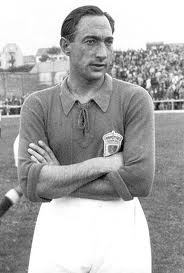
Spain enjoyed the biggest win of qualification, beating Portugal 9-0 in Madrid. They scored their first goal after only three minutes and never looked back, going up 3-0 by the break. The 9-0 final score included five goals from Real Oviedo striker Isidro Lángara (pictured).

Germany also scored their first goal after only three minutes with a goal from Vfl Benrath forward Josef Rasselnberg. Playing at Luxembourg's Stade Municipal, Germany were up 0-3 when the hosts scored in the 27th minute, then extended their lead to 1-5 before halftime. Rasselnberg added three more goals to the final score of 1-9.

Both Spain and Germany qualified easily--Spain beat Portugal again, 1-2, while Germany did not need another match. In their group's next game, France beat Luxembourg 1-6, so both France and Germany advanced without having to play their group's final scheduled match. In the tournament proper, Spain fell to eventual winners Italy in the quarterfinals, while Germany lost to eventual runners-up Czechoslovakia in the semifinals.

Friday, February 11, 2011

12 February 2003 - Raúl Takes Two To Become Number One

On 12 February 2003, Raúl González scored two goals in a 3-1 win over Germany to become Spain's all-time top scorer.

Raúl, who played 16 seasons at Real Madrid before moving to Schalke in 2010, made his first full international appearance in 1996. He scored only five times in his first three years, but hit his stride in 1999 with ten goals--the most ever scored for Spain by one player in a single year. He never replicated that performance, but continued to be a reliable striker and took over as captain in 2002.

The friendly with Germany came in the midst of Spain's qualification campaign for Euro 2004. Played in Mallorca, Raúl scored the opening goal in the 30th minute. It was the 30th of his career, beating the former record of 29 held jointly with his Real Madrid teammate Fernando Hierro. Germany's Fredi Bobic equalized for the visitors eight minutes later, but Raúl restored the lead in with a 77th-minute penalty kick. Guti added a third for the hosts to end the day at 3-1.

Raúl scored a total of 44 goals for Spain before his retirement from international play in 2006. While still a record, it is shared with Barcelona forward David Villa who looks likely to surpass it this year.

Monday, January 3, 2011

4 January 1909 - Hola, España!

On 4 January 1909, representatives of several clubs met in Madrid to form the Spanish football federation. The meeting was held at the offices of Real Madrid, with club president Adolfo Meléndez serving as the federation's first secretary.

Originally named the Federación Española de Clubs de Football, the new organization followed the model of England's FA, with the express purpose of creating a Spanish national team. After 11 years, they finally accomplished that mission when Spain played their first full international, a 1-0 win over Denmark in the 1920 Summer Olympics, where they took the silver medal. It took them another 44 years to win their first major honor, the 1964 European Championship, which they followed with an Olympic gold medal in 1992.

In February 2007, they began a record-tying unbeaten run of 35 unbeaten matches that included the 2008 European Championship. Despite those successes, critics labeled Spain as underachievers for failing to advance farther in the World Cup than their fourth-place finish in 1950. That ended in 2010, when Spain lifted the Cup over the Netherlands in a dramatic extra-time Final (see the highlights below).

Now known as the Real Federación Española de Fútbol, or RFEF, the federation oversees the top four levels of the Spanish football pyramid, as well as both men's and women's national teams and the national futsal team.

Monday, November 15, 2010

VIDEO : Spain Team New Jersey Advert - Awesome

Spain team has introducing their new cool jersey in an advert, with the help of David Villa, Llorente, and Xabi Alonso. Cool ad, you should watch it !!

Friday, October 8, 2010

Spanish Team New Formation

Facing the second matchday on Euro 2012 qualifier Group I at Estadio El Helmantico Salamanca, Del Bosque will give a place for Spanish League players on his new formation.

Osasuna Nacho Monreal, Bruno Soriano and Borja Valero from Villarreal, plus Valencia's Pablo Hernandez and Aritz Aduriz will be replacing the Spanish stars who suffered with injury. Raul Albiol from Madrid, Xavi Hernandez from Barcelona, Cesc Fabregas, Jesus Navas, Juan Mata, Pedro Rodriguesz and Fernando Torres won't be able to perform due to injury.


The squad:

Goal keeper : Iker Casillas (Real Madrid) , Pepe Reina(Liverpool), Victor Valdes(Barcelona)
Backfielders : Sergio Ramos(Real Madrid), Alvaro Arbeloa (Real Madrid), Gerard Pique(Barcelona), Carles Puyol(Barcelona), Carlos Marchena(Villarreal), Joan Capdevilla(Villarreal), Nacho Monreal(Osasuna).
Midfielders : Xabi Alonso(Real Madrid), Sergio Busquets(Barcelona), Santi Cazorla(Villarreal), Andres Iniesta(Barcelona), Bruno Soriano(Villarreal), Borja Valero(Villarreal)
Forward : Pablo Hernandez(Valencia), David Silva(ManCity), Aritz Aduriz(Valencia), Fernando Llorente(Athletic Bilbao), David Villa(Barcelona)

Friday, October 1, 2010

2 October 1999 - The Shaggy DF

On 2 October 1999, 21-year old Barcelona defender Carles Puyol made his first-team debut in a 2-0 win at Real Valladolid. Since then, Puyol has made almost 500 appearances for the senior side and has captained them to several honors, including four La Liga titles and two UEFA Champions League trophies.

Easily recognized by his long curly hair, Puyol started his career in 1993 with the Pobla de Segur junior squad, but moved to Barça's youth academy in 1995, then to their B squad in 1997. He originally joined the Catalan squad as a defensive midfielder, but switched to right back, then to center back. He was named captain at the end of the 2003-04 season. The move coincided with Barça's return to glory, as the following season, he led the team to their first La Liga title in six years. Then, in 2005-06, they won the league and the Champions League.

In total, Puyol has won four La Liga titles, two Champions League trophies, one Spanish Cup, four Spanish Supercups, one UEFA Supercup, and one FIFA Club World Cup. In 2010, he won the FIFA World Cup with Spain.

Wednesday, September 8, 2010

9 September 2009 - A Man Who Can Keep His Own Laundry Clean

On 9 September 2009, Spain defeated Estonia in a World Cup qualifier. The win booked their place at the 2010 World Cup and secured a national team clean sheet record for keeper Iker Casillas.

Played before a crowd of 14,362 at the Estadio Romano in Mérida, the hosts posted a first-half lead with a goal from midfielder Cesc Fabregas in the 33rd minute. But Estonia kept the match close with a couple of narrow misses and maintained the one-goal deficit deep into the second half. Spain finally managed to extend their lead when substitute Santi Cazorla found the net in the 79th minute. Fellow substitute Juan Manuel Garcia Mata added a final goal in the 90th minute.

The win ensured that Spain would finish at the top of their qualification group and advance to the World Cup. By keeping Estonia scoreless, the match also counted as Casillas' record-breaking 56th clean sheet for Spain, one more than previous record holder Andoni Zubizarreta.

Saturday, June 26, 2010

27 June 2006 - France Over Spain, Just Like On The Map

On 27 June 2006, France came back from a one-goal deficit to beat favored Spain 3-1 in the World Cup Round of 16. It was a performance that sent the French on their way to the Final, where they eventually lost to Italy on penalty kicks.

Les Bleus had struggled in the group stage, managing one win (over Togo, 2-0) and two draws (0-0 with Switzerland and 1-1 with South Korea), but finished in their group's second and last advancement spot. Spain, on the contrary, roared through the first round with wins over the Ukraine (4-0), Tunisia (3-1), and Saudi Arabia (0-1) to finish at the top of Group H.

In the Round of 16, it appeared that La Furia Roja were on their way to another win after French defender Lillian Thuram conceded a penalty by knocking Spanish center back Pablo Ibáñez over in the box in the 28th minute. Striker David Villa sent the spot kick to the bottom left corner of the net, just past the outstretched hands of keeper Fabian Barthez, and Spain were up 1-0.

But in the 41st minute, a well-timed Patrick Vieira pass found Franck Ribéry slipping past the Spanish back line. He rounded keeper Iker Casillas and prodded the ball home to draw France level. Vieira then provided the go-ahead goal in the 83rd minute, as Spain were unable to handle Zinedine Zidane free kick. It bounced to Vieira in the box and he headed it into the net. Spain pushed forward in search of an equalizer, but were exposed on the counter-attack as Zidane added an insurance goal in the 92nd minute.

Monday, June 21, 2010

22 June 2002 - Where No Asian Team Has Gone Before

On 22 June 2002, co-hosts South Korea became the first Asian team to advance to the World Cup semifinals by beating Spain on penalties, 0-0 (3-5). Their win, however, came with a bit of controversy.

Spain dominated the first half, with 20-year old Betis midfielder Joaquín Sánchez providing a spark on the right side. But the South Korean defense proved stout and kept the match scoreless in the first half. Spain thought they cracked the Korean's back line mid-way through the second half when a Spanish free kick bounced into the net off the shoulder of Korean center back Kim Tae Young, but the referee disallowed the goal for an apparent foul.

In the second minute of extra time, Spain again thought they had the match-winner when Joaquín ran along the byline and chipped the ball into forward Fernando Morientes, who headed it into the goal. The referee disallowed that goal after the linesman signaled - incorrectly - that the ball had gone out of bounds before the pass.

In the ensuing shootout, Korea went first and were up 4-3 when Joaquín stepped up to the spot. But his shot was tame and easily saved by Korean keeper Lee Woon Jae. The final shot by Korean captain Hong Myung Bo then clinched the victory. South Korea advanced to the semifinals, where they lost to Germany 1-0.

Saturday, June 5, 2010

6 June 1962 - No Pelé, No Problem

On 6 June 1962, defending World Cup champions Brazil defeated Spain 2-1 in the final group stage match for both teams. The win secured Brazil's position at the top of the table and sent Spain to the bottom, eliminating them from the tournament.

Spain started the day in the group's third place, behind Brazil and Czechoslovakia, but ahead of Mexico, and a win would have guaranteed their advancement to the knockout rounds. They were encouraged by Pelé's absence from the Brazilian side, as he was injured in the previous match, and took advantage by going up 0-1 in the 35th minute.

They held onto the lead deep into the second half of the free-flowing attacking match, but were undone by Pelé's replacement, Amarildo (pictured, receiving a congratulatory kiss from Pelé). Amarildo scored a 72nd-minute equalizer, then headed in the match-winner in the 86th minute. They were two of the three goals he scored in the tournament - he scored the third in the Final to bring Brazil level with the Czechs.

Brazil went on to beat Czechoslovakia in the Final, 3-1, to claim their second consecutive Jules Rimet trophy.

Thursday, June 3, 2010

4 June 1950 - The Magical Magyars

On 4 June 1950, Hungary defeated Poland in a friendly, 5-2. It was the first of Hungary's record-setting 31-match unbeaten streak that lasted until the 1954 World Cup Final.

The previous record was held by Scotland, who went 22 consecutive matches without a loss. Hungary eclipsed that mark on 15 November 1953, when they drew 2-2 with Sweden in a friendly. Not all of the matches in Hungary's streak were friendlies, however; it included a five-match run in the 1952 Olympics that ended with Hungary, nicknamed the "Magical Magyars," winning the gold medal with a 2-0 win over Yugoslavia. They also won the Central European Cup in 1953 over fellow competitors Italy, Austria, and Czechoslovakia.

Hungary's record stood at 27 when they arrived in Switzerland for the 1954 World Cup and they promptly extended it with lopsided group-stage wins over South Korea (9-0) and West Germany (8-3). The Hungarians, led by their star pairing of forwards Sándor Kocsis and Ferenc Puskás, then advanced through the knockout rounds with tough wins over 1950 runners-up Brazil and holders Uruguay, before meeting West Germany again in the Final, where the streak finally ended with a 3-2 loss.

Hungary's streak remained a record for 55 years until it was beaten by Spain's 33rd consecutive unbeaten match on 14 June 2009. Spain won two more matches to set the current record at 35.

Monday, May 3, 2010

4 May 1987 - Let's Talk About Cesc, Baby

On 4 May 1987, future Arsenal captain and Spanish international Francesc "Cesc" Fàbregas i Soler was born in the city of Vilassar de Mar, Catalonia, Spain. Just over nineteen years later, he would become the youngest person to play for Spain in a World Cup.

He started his career in the youth squad of Catalonian side Mataró, but moved to Barcelona's youth academy when he was 10 years old. Despite impressive performances for the Barça reserves, he had failed to crack the first team by 2003 and moved to London to play for Arsenal. He did not play in any League matches for the Gunners in the 2003-04 season, but became their youngest first team player in history when he played in a League Cup match against Rotherham United on 23 October 2003. Just over a month later, he became the club's youngest-ever goalscorer when he netted in their 5-1 League Cup win over Wolves.

By the 2005-06 season, Fàbregas had solidified a starting position in the Arsenal midfield and was a key member of their run to that season's Champions League Final, where they lost 2-1 to his old club, Barcelona. His performance that season impressed Spanish manager Luis Aragonés, who called Fàbregas up for a friendly against the Ivory Coast on 1 March 2006, making him the youngest player to be capped by Spain for over 70 years.

He remained with the national side for the 2006 World Cup, making his first tournament appearance as a second-half substitute against the Ukraine on 14 June 2006. At 19 years, 41 days old, he remains the youngest player to appear for Spain in a World Cup. He later helped guide Spain to the Euro 2008 title, scoring the winning penalty in their quarterfinal shootout against Italy.

Tuesday, March 16, 2010

17 March 1954 - Spain Gets Tossed Out Of The World Cup

On 17 March 1954, Spain and Turkey met in Rome for a World Cup qualifying play-off, having split their two previous matches with one win apiece. With a World Cup trip at stake, the teams battled to a 2-2 draw through extra time, so the winner was decided by a coin toss.

There were 13 qualifying groups for the 1954 World Cup, with four of them -- including Spain's and Turkey's Group 6 -- having only two teams. In those groups, the teams played each other twice, once home and once away, earning two points for a win and one point for a draw. The group winners qualified for the Cup, while the runners-up went home.

The two sides first met in Madrid on 6 January 1954, with the hosts cruising to an easy 4-1 victory. In the second match, played in Istanbul on 14 March, the Turkish defense performed better, holding the Spanish scoreless in Turkey's 1-0 win. Unfortunately for Spain, the rules at the time did not consider goal differential, so a replay was required to decide the outcome.

FIFA scheduled the replay for 17 March, choosing Rome as a neutral ground. Spain took the lead with an 18th-minute goal from forward José Luis Arteche, but Turkey got a 32nd-minute equalizer from forward Burhan Sargin (pictured), who had scored the crucial goal in Istanbul. Sargin's fellow forward Suat Mamat then scored in the 65th minute to give the Turks a late lead. There was still time for Spain to rally, however, and forward Adrián Escudero brought his side level in the 79th minute. They played to a stalemate for the rest of regulation, then through extra time.

With no penalty-kick provision in place at the time, the winner was decided by chance. Some reports say that the winner was chosen by drawing lots, but FIFA says "their fate was decided by the toss of a coin, with the Turks calling correctly." In any event, the result was the same: the Spanish, despite outscoring their opponents 6-4 over the course of three matches, were sent home and Turkey advanced to the World Cup, where they were eliminated in the group stage.

Monday, December 21, 2009

22 December 2004 - Racism Rears Its Ugly Heads

On 22 December 2004, FIFA fined the Spanish Football Federation €60,000 as punishment for racist chants during a friendly between Spain and England at the Bernabéu Stadium the previous month.

The abuse consisted of monkey chants directed against England's black players, including defenders Ashley Cole and Rio Ferdinand, as well as substitutes Jermaine Jenas, Shaun Wright-Phillips (pictured), and Jermain Defoe. While such chants have a regrettably long history in football, the chants at the Bernabéu were notable for the pervasive participation of the crowd--according to one spectator, 80% of the crowd were chanting.

The event came on the heels of an earlier incident in September, when Spain manager Luis Aragonés had been overheard calling Thierry Henry a "black shit" when trying to motivate Henry's Arsenal teammate, Spanish international José Antonio Reyes.

The incident drew wide condemnation from authorities and commentators in several countries, including Spain itself. Afterward, the Spanish Football Federation began work on an anti-racism campaign.

Saturday, November 14, 2009

15 November 2006 - The Reign Of Spain Starts After This Game

On 15 November 2006, Romania defeated Spain, 0-1, in a friendly played in Cadiz. The match was Spain's last loss before going on a world record-setting run of 35 matches unbeaten, a streak that also saw them win the 2008 European Championship.

Spain limped into the match against Romania, having been eliminated from the 2006 World Cup by France in the first knockout round and losing their last two matches, a couple of 2008 UEFA Euro qualifiers against Northern Ireland and Sweden. Manager Luis Aragonés shook up his side for the match, calling up Valencia star David Silva for his senior debut along with Celta Vigo's Angel Lopez and Sevilla's Javi Navarro.

Silva threatened a couple of times during a scoreless first half, but Romanian striker Ciprian Marica notched the match's only goal when he beat Iker Casillas with a low second-half shot into the far corner.

Spain rallied after the loss, rattling off a string of 35 unbeaten matches (32 wins, 3 draws) over the next three years. The highlight of that streak was the 1-0 win over Germany in the 2008 UEFA Euro Final. The United States finally ended the run, beating Spain 2-0 on 24 June 2009 in the semi-finals of the 2009 Confederations Cup.