Showing posts with label Pelé. Show all posts

Monday, October 10, 2011

11 October 1962 - He Really Did Earn That Reputation, You Know

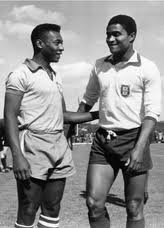
On 11 October 1962, Pelé won the battle of superstars, outdoing Eusébio with a hat-trick to helped Santos beat Benfica for their first Intercontinental Cup.

The contest matched Santos, the reigning Copa Libertadores champions, against European Cup winners Benfica. In the first leg, played at the Maracaña on 19 September, Pelé scored an 85th-minute match-winner with the final score of 3-2.

In the second leg, played in Lisbon's Estádio da Luz, the striker picked up where he left off, opening the scoring in the 15th minute with a sliding tap-in from a low cross. Ten minutes later, he doubled lead with an impressive finish after avoiding two tackles, then blowing by a third defender.

Santos stretched their lead to five after a goal from Coutinho (48'), another from Pelé (64'), and one from Pepe (77') before Benfica finally got on the scoresheet with an 85th-minute goal from Eusébio. Four minutes later, they cut the margin to 2-4 after a strike from Joaquim Santana (who had provided both of their goals in the first leg). But it was too little, too late for the Portuguese side as they fell to Santos, 2-5.

It was the second time Benfica had conceded five goals in the Intercontinental Cup--they lost 5-0 to Peñarol in the second leg the year before, then fell 2-1 in the play-off. Santos had better luck in the competition, repeating as champions in 1963 by beating AC Milan.

Thursday, September 29, 2011

30 September 1962 - Santos Liberate The Cup

On 30 September 1962, a brace from Pelé helped Santos capture their first Copa Libertadores, beating two-time defending champions Peñarol in a replay.

Peñarol were appearing in their third straight final after winning the first two editions of the tournament in 1960 and 1961. Santos, meanwhile, were in the final for the first time. The two teams had finished the first two legs with one win each, with the Brazilians taking a 1-2 victory in Montevideo and the Uruguayans returning the favor in São Paulo, 2-3.

Level with two points each, the tournament rules required a replay at a neutral venue to determine the winner. Playing before a crowd of 60,000 at the Estadio Monumental in Buenos Aires, Peñarol were wrong-footed early when their midfielder Omar Caetano put the ball into his own net in the 11th minute. Peñarol were unable to put the ball into Santos' net, however, while 20-year old Pelé, who had scored twice in the first round, doubled his tournament tally with goals in the 48th and 89th minutes to seal the 3-0 victory.

It proved to be the start of a strong international run for Santos, who went on to repeat as Copa Libertadores champions in 1963 while following both wins with victories in the Intercontinental Cup.

Saturday, September 10, 2011

11 September 1963 - A Second For Santos

On 11 September 1963, Santos overpowered Boca Juniors to win their second consecutive Copa Libertadores. And just like the previous one, Pelé provided the clinching goal.

The final was played over legs; in the first, played at the Maracaña in Rio de Janeiro, Santos won 3-2 with a trio of first-half goals from Coutinho (2', 21') and Antônio Lima dos Santos (28'). Under the rules in place at the time, the winner was determined by points, with two points for a win and one point for a draw, with goal differential not taken into account. So, in the second leg, the best Boca could hope for was a win to force a deciding replay.

Playing before a crowd of about 50,000 at the Estadio Camilo Cichero in Buenos Aires, they looked on track to meet that goal after taking a 1-0 lead in the 46th minute thanks to a goal from striker José Sanfilippo. But only four minutes later, Coutinho scored an equalizer. Then, while Boca pressed forward for a life-preserving goal, Pelé struck, finding the net in the 82nd minute and snuffing Boca's hopes for a replay.

The goal was Pelé's fifth of the tournament, making him its second-highest scorer behind Sanfilippo, who had 7.

While the win denied Boco their first Copa Libertadores title, they went on to become one of the most successful teams in the competition, winning it a total of 6 times between 1977 and 2007. Santos, meanwhile, won it for a third time in 2011.

Wednesday, June 15, 2011

16 June 1950 - The Sistine Chapel Of Football

On 16 June 1950, an all-star match inaugurated the new Municipal Stadium in Rio de Janeiro. Now known as the Maracanã, it is one of the most famous football venues in the world.

The stadium was built for the 1950 World Cup with a capacity of just under 200,000, making it was one of the world's largest stadiums at the time. Construction began in 1948 was not fully completed for the opening match--the stadium still lacked toilets and showed signs of ongoing work. Nevertheless, a group of Rio de Janeiro All-Stars defeated a group of São Paulo All-Stars 3-1, with Fluminense midfielder Valdir "Didi" Pereira scoring the first goal for the home side.

The stadium's most famous match, nicknamed the "Maracanazo," came in the 1950 World Cup, as Uruguay upset Brazil to claim the trophy. It was also the place where Pelé scored "O Milésimo," his 1,000th career goal, in 1969.

Since then, it has hosted matches for Rio's four prominent clubs, Vasco da Gama, Botafogo, Flamengo, and Fluminense. In 1966, it was renamed the Estadio Jornálista Mário Filho, after a local journalist who championed the stadium's construction. But it is still known as the Maracanã, after a local river which, in turn, is named after a type of parrot common to the area.

In 2014, the World Cup will return to the Maracanã, which is scheduled to host the Final.

Sunday, March 13, 2011

14 March 1973 - Plymouth Rocks Pelé

On 14 March 1973, fresh off their defeat to Fulham two days earlier, Santos FC continued their England tour with a friendly against Third Division side Plymouth Argyle. And lost again.

Controversy erupted before the Brazilian side even took the pitch. According to Argyle chairman Robert Daniel, Santos officials refused to let the team play unless the hosts ponied up an additional £2,500 more than the contracted fee. Daniel initially refused, but with a capacity crowd of over 37,000 at Plymouth's Home Park to see world-famous players such as 1970 World Cup winners Carlos Alberto, Edú, and the most celebrated player of all, Pelé, he eventually capitulated and paid the extra amount.

He was glad he did, as Argyle took a 3rd-minute lead with a rocket from Mike Dowling, who fired the ball from outside the box into the top right corner of the net. A diving header from Derek Rickard doubled their lead, then a failed attempt by Santos keeper Claudio to corral a cross allowed Argyle's Jimmy Hinch to slot in from close range and extend the margin to 3-0 by the break. When the halftime whistle blew, supporters rushed onto the pitch and swarmed around Pelé seeking autographs.

The second half was a different story, as a penalty kick from Pelé and a late goal from Edú closed the gap to 3-2, but that was it. Argyle held on until full time to claim one of their most historic victories.

(For video of the match, please visit http://www.greensonscreen.co.uk/santos72H.asp.)

Friday, March 11, 2011

12 March 1973 - Pelé Comes To London

On 12 March 1973, Pelé and Santos FC visited London for a friendly against Second Division Fulham. And lost 2-1.

Although Pelé had been in England with Brazil for the 1966 World Cup, all of Brazil's matches had been played at Goodison Park, making the Fulham match his first in the English capital. His Santos teammates that day included fellow 1970 World Cup winners Carlos Alberto and Edú.

A season-high crowd of 21,464 turned out at Craven Cottage for the game. Pelé, who was already an established international star, was the center of attention, receiving rounds of applause every time he touched of the ball. But Edú turned in the most impressive performance for the visitors with a combination of speed and style.

Santos went ahead with a penalty kick from Pelé, who slipped the ball past Fulham keeper Peter Mellor, but the Cottagers fought back. Midfielder Alan Pinkney, not generally known as a scorer, provided the equalizer, while striker Steve Earle scored the winning goal. It was a hard-fought victory for the hosts; post-match reports described the Fulham players as looking exhausted, while the Brazilians appeared to have barely broken a sweat.

Afterward, a dispute arose between the two clubs, as Santos believed that Fulham had short-changed them on their percentage of the gate. Any animosity between Fulham and Pelé did not last, though, as he later went on to scout for the club in 2002.

Sunday, December 19, 2010

20 December 1992 - The Cosmos Lose A Star

On 20 December 1992, New York Cosmos founder Steve Ross died in Los Angeles at the age of 65.

Ross (pictured, center), who started his entrepreneurial career with a rental car business in the late 1950s, purchased the Warner Brothers-Seven Arts film studio in 1969 for $400 million. Ross served as CEO, president, and chairman of his new acquisition, soon expanded and renamed as Warner Communications.

Ross, along with brothers Ahmet and Neshui Ertegün from Atlantic Records, founded the Cosmos in 1971. With a collection of local talent, the Cosmos won the NASL title in their second season, but could not sustain their success, failing even to qualify for the playoffs in 1974. Their declining form prompted Ross to make a bid for Brazilian superstar Pelé, who came out of semi-retirement and joined the Cosmos in 1975. Ross also used Warner Communications' deep pockets to bring additional high-profile players to New York, including Franz Beckenbauer, Carlos Alberto, and Giorgio Chinaglia.

Under Ross' stewardship, the Cosmos became a club célèbre, becoming a prominent fixture in the New York social scene. They were also successful, winning four more NASL titles. But the extravagant spending eventually caught up with them and Warner sold the club in the early '80s to a consortium led by Chinaglia, ending Ross' association with the club.

Ross's death in 1992 was caused by complications with prostate cancer.

Monday, November 1, 2010

2 November 1997 - The Center Is Probably Still Holding It

On 2 November 1997, football featured on The Simpsons for the first--but not last--time.

That day's episode, titled "The Cartridge Family," centered on the problems created by Homer's purchase of a handgun. But it opened with the Simpson family attending a match between Mexico and Portugal, lured by the possibility of getting autographs from stars such as "Ariaga, Ariaga II, Bariaga, Aruglia, and Pizzoza!" There's also an appearance by Pelé, who receives a sack of cash for promoting Crestfield Wax Paper.

The Springfield crowd soon gets bored with the match (in contrast to the foreign announcer, based on Andrés Cantor, who loudly describes the action as the "center holds it! Holds it! HOLDS IT!") and erupts into violence. It starts when Lenny punches Principal Skinner, but turns into a full-blown riot when Groundskeeper Willie and his Scottish friends jump into the fray. After it spreads out of the stadium, Mayor Quimby declares mob rule, which results in Homer getting a gun.

Football returned to The Simpsons 10 years later with a guest appearance by Ronaldo.


Thursday, September 30, 2010

1 October 1977 - The End Of An Era

On 1 October 1977, Pelé played the last match of his outstanding career - an exhibition between his two former clubs, the New York Cosmos and Santos, with Pelé playing one half for each side.

The match was played at New Jersey's Giants Stadium before a capacity crowd of 77,000 that included such luminaries as President Jimmy Carter and Muhammad Ali. After a pre-match speech in which he asked the crowd to chant "love" three times, Pelé played the first half for the Cosmos and the second for Santos.

Santos took the lead with a first-half goal from Reynaldo, but Pelé equalized for the Cosmos off a direct free kick. It was the final goal of his career. At the half, the Cosmos retired his jersey as he exchanged it for a Santos shirt. His replacement for the Cosmos, striker Ramon Mifflin, then scored the match winner in the second half.

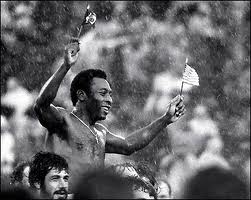
When the match ended, several Cosmos players lifted Pelé and carried him around the stadium as he held a US flag in one hand and a Brazilian flag in the other.

Thursday, July 29, 2010

30 July 1981 - Rocky Takes The Pitch

On 30 July 1981, Paramount Pictures released Victory, a film about a group of football-playing Allied prisoners of war in a German prison camp during WWII. Known as Escape to Victory outside of North America, the movie starred Michael Caine and Sylvester Stallone alongside a group of real-life footballers including Pelé and Bobby Moore.

Based loosely on the 1941 "match of death" between Soviet prisoners and a German Army team, the film follows a group of POWs who agree to play an exhibition match against their captors and assemble a side led by Englishman Captain John Colby (played by Michael Caine). Pelé's character, Corporal Luis Fernandez, is from Trinidad and Tobago, while Stallone plays the team's inexperienced goalkeeper, American Captain Robert Hatch.

Hatch organizes a plan for several of the POWs to escape at halftime, but, despite being down at the break due in part to biased officiating, they are convinced to stay in attempt to win the match. Near the end, with the sides even at 4-4, Fernandez scores the potential match-winning goal, but is incorrectly ruled offside. Shortly afterward, as time is about to expire, the referee awards the Germans a penalty kick, but it is saved by Hatch, causing a celebration in the stands. Using the celebration as cover, the POWs then escape.

In addition to Pelé and Moore, the cast included Tottenham Hotspur star midfielder Osvaldo Ardiles, Manchester City midfielder Kazimierz Deyna, and several players from Ipswich Town.

Sunday, June 20, 2010

21 June 1970 - Brazil Literally Wins The World Cup

On 21 June 1970, Brazil became the first team to win three World Cup trophies, beating Italy 4-1 in that year's Final. In that match, Pelé became the first (and to date only) player to win three trophies and Brazil manager Mário Zagallo became the first person to win trophies as a player and coach.

Playing before a crowd of 107,412 at the Estadio Azteca in Mexico City, Pelé opened the scoring with a powerful 18th-minute header. Italy found a first-half equalizer in the 37th minute thanks to confusion between Brazilian keeper Félix and defender Hércules Brito. As the keeper rushed forward to stop the Italian attack, Brito charged in and knocked the ball away, allowing Italian forward Roberto Boninsegna to slot it into an open net.

Level at 1-1 at the break, the second half belonged to Brazil. Gérson put them up 2-1 with a low driving shot from outside the box in the 66th minute. Five minutes later, a long pass found Pelé in the box and he headed the ball down into the path of the charging Jairzinho, who bundled it into the net. The scoring ended in the 86th minute as a precise Brazilian build-up involving eight different players resulted in a Pelé pass to captain Carlos Alberto, who blasted the ball home from about 10 yards out. It was a brilliant example of Brazil's now famous style of play.

With their third World Cup title, Brazil were allowed to keep the trophy. Unfortunately, it was stolen in 1983 and has never been recovered.

Monday, June 7, 2010

8 June 1958 - The Journey Of Five World Cup Trophies Starts With A Single Win

On 8 June 1958, Brazil started their World Cup campaign with a 3-0 win over Austria before a crowd of 17,778 at the Rimnersvallen in Uddevalla, Sweden. It was the first step toward securing the first of their record five World Cup trophies.

The Austrians were optimistic, having advanced to the semifinals in 1954, but were overwhelmed from the start by the Brazilians' free-flowing attack. Forward José Altafini, better known as "Mazzola," scored the first goal with blast from distance in the 37th minute, then defender Nílton Santos, playing in an advanced position, blew past an Austrian defender in the 50th minute and chipped the ball over the diving keeper to put Brazil up 2-0. Mazzola rifled the final shot in the 85th minute to complete the win.

It was a powerful performance, especially considering that Brazil left Pelé, Garrincha, and Vavá on the bench. All were instrumental throughout the remainder of the tournament, which ended with Brazil winning the Final 2-5 over hosts Sweden.

Saturday, June 5, 2010

6 June 1962 - No Pelé, No Problem

On 6 June 1962, defending World Cup champions Brazil defeated Spain 2-1 in the final group stage match for both teams. The win secured Brazil's position at the top of the table and sent Spain to the bottom, eliminating them from the tournament.

Spain started the day in the group's third place, behind Brazil and Czechoslovakia, but ahead of Mexico, and a win would have guaranteed their advancement to the knockout rounds. They were encouraged by Pelé's absence from the Brazilian side, as he was injured in the previous match, and took advantage by going up 0-1 in the 35th minute.

They held onto the lead deep into the second half of the free-flowing attacking match, but were undone by Pelé's replacement, Amarildo (pictured, receiving a congratulatory kiss from Pelé). Amarildo scored a 72nd-minute equalizer, then headed in the match-winner in the 86th minute. They were two of the three goals he scored in the tournament - he scored the third in the Final to bring Brazil level with the Czechs.

Brazil went on to beat Czechoslovakia in the Final, 3-1, to claim their second consecutive Jules Rimet trophy.

Tuesday, April 13, 2010

14 April 1912 - The Saints Go Marching In

On 14 April 1912, a group of footballers in the Brazilian city of Santos, located in the state of São Paolo, founded a new football club which they named Santos FC. The club credits their formation to three men in particular - Raimundo Marques, Mário Ferraz de Campos, and Argemiro de Souza Júnior. But they are best known as the 17-year home of Pelé.

Santos enjoyed some modest early success, winning a handful of regional competitions starting with the Santos City Championship in 1913 and 1915, but they reached their highest heights only after the arrival of the then 15-year old Pelé in 1956. Within a few short years, Santos were established as a national power, winning five consecutive Brazilian Cups from 1961 through 1965. During that period, they also twice won South America's Copa Libertadores (1962 and 1963).

After Pelé's departure in 1974 for the New York Cosmos, Santos went into decline. They enjoyed a resurgence in the early 2000s, however, winning the Brazilian top flight in 2002 and 2004 with help from their skillful young forward Robinho.

Robinho left in 2005 for Real Madrid, triggering another dip in Santos' fortunes. They finished mid-table in 2009, finishing 12th out of 20 teams, but will enter the 2010 season next month with renewed optimism, having signed Robinho back on loan from Manchester City, whom he joined in 2008.

Friday, March 26, 2010

27 March 2002 - He May Have Won The Match, But He Got Screwed On The Shirt Deal

On 27 March 2002, the shirt worn by Pelé in the 1970 World Cup Final sold at an auction for a record £157,750. The bid, placed by an anonymous telephone bidder, smashed the expected sale price, estimated by Christie's auction house at a mere £50,000.

The shirt still had grass stains from the Final, in which Pelé scored the opening goal in Brazil's 4-1 win over Italy. The shirt was auctioned by Italian defender Roberto Rosato, who acquired it by swapping shirts with Pelé at the end of the match.

The sale beat the previous auction record of £91,750, paid for the shirt worn by England's Geoff Hurst in the 1966 World Cup Final.


Wednesday, December 16, 2009

17 December 2007 - Yet Another Brazilian Hat-Trick

On 17 December 2007, FIFA presented its World Player of the Year awards. It was a sweep for Brazil, with Kaká and Marta named World Player of the Year and Women's World Player of the Year, respectively. It was the first--and to date only--time a single nation claimed both awards.

Earlier that year, Kaká led AC Milan to the 2006-07 Champions League title, finishing as the tournament's top scorer with 10 goals. Marta, meanwhile, had helped her club, Swedish side Umeå IK, claim a double, winning both the league and the Swedish Cup. She also led them to that year's UEFA Women's Cup Final, where they lost to Arsenal LFC, 1-0.

The 2007 award was the second consecutive Player of the Year award for Marta, who won it a third time in 2008.

Brazil walked away with a total of three honors, as FIFA conferred the 2007 Presidential Award on Pelé for his years of service to the game.

Wednesday, November 18, 2009

19 November 1969 - O Milésimo

On 19 November 1969, Santos defeated Vasco da Gama away, 1-2, before a crowd of over 65,000 at the Maracanã Stadium in Rio de Janeiro. The winning goal was scored by 29-year old Santos forward Pelé--his 1,000th goal for club and country.

The Brazilian public was eager to see the goal, known as "o milésimo." In Santos' previous match, with Pelé sitting on 999 goals, the home crowd booed when one of their own players blocked one of Pelé's subsequent shots. The Vasco da Gama supporters were no different, cheering each of his attempts on 19 November. The Vasco da Gama players, however, were eager to prevent the milestone from occurring against them. Indeed, when a Santos player sent in a cross for Pelé, a Vasco defender headed it into his own goal rather than allow Pelé to receive it.

The moment finally arrived late in the match after Pelé was tripped in the box and the referee signaled for a penalty. Pelé calmly stepped up to the spot and slotted a low shot into the bottom right corner to claim the win. The crowd invaded the pitch and carried Pelé away on their shoulders.

By the time he retired in 1977, Pelé had scored a record-setting 1,281 goals. While some critics claim that several of the goals should not count because they were scored in friendlies, FIFA nevertheless recognizes Pelé's 1,281 goals as the most ever scored by a professional footballer.

Thursday, October 22, 2009

23 October 1940 - If Football Is Your Religion, Today Is Your Christmas

On 23 October 1940, Edson Arantes do Nascimento was born in Três Corações, Brazil. Better known as "Pelé," he went on to become one of football's first global superstars.

He began his professional football career with Brazilian club Santos, for whom he played from 1956 to 1974. During that time, Santos won loads of silverware, including ten league titles and five Taça Brasil trophies. Pelé made 656 official appearances for Santos in all competitions, scoring 643 goals. He was the Brazilian top flight's top scorer eleven times.

Between 1957 and 1971, he made 92 appearances for the Brazilian national team. He scored 77 goals, making him the national team's all-time top scorer. Along the way, he became the only footballer to be a member of three World Cup-winning teams (1958, 1962, 1970).

In 1975, he signed with the New York Cosmos, helping them to the league title in 1977.

He played his last match on 1 October 1977, an exhibition between the Cosmos and Santos. Pelé played the first half for New York, scoring on a free kick. He then switched sides to play for Santos in the second half. New York won 2-1. After the match, several Cosmos players carried Pelé around the field while he held up the flags of Brazil and the United States.

Pelé reportedly acquired his nickname as a schoolboy due to his mispronounciation of the last name of Vasco de Gama goalkeeper Bilé.


Tuesday, September 15, 2009

16 September 1992 - The Original Black Pearl

On 16 September 1992, Moroccan-born French international midfielder Larbi Benbarek died in his home in Casablanca at the age of 75.

Nicknamed "the Black Pearl," Benbarek has been hailed as the first African football star. He was born in Casablanca in 1914 and played professionally for his hometown clubs Idéal Club Casablanca (1930-34) and US Marocaine (1934-38) before moving to France to sign with Marseille at the age of 20. He stayed with Marseille until 1939, scoring 10 goals in 30 league appearances, before the onset of World War II forced him back to Morocco. Before he left, he had made four appearances for the French national team.

He stayed with Marocaine for the duration of the war, but moved back to Europe when the war ended to play for Stade de Français (1945-48), Atlético Madrid (1948-53) and again with Marseille (1953-55). He also resumed his career with the French national team, making a total of 17 appearances between 1938 and 1954.

In 1955, he again returned to Morocco, where he played for Sidi-Ben-Abbes for a season. He retired from playing in 1956. He briefly managed to Moroccan national side in 1957, and again in 1960, before retiring from football completely.

Soccer legend Pelé reportedly once said about Ben Barek: "If I am the king of soccer, then Larbi Benbarek is the god of it." In 1998, FIFA posthumously awarded him its highest honor, the FIFA Order of Merit.

Monday, July 6, 2009

7 July 1957 - And Sometimes A Bright Start Leads To A Bright Future

On 7 July 1957, Edson Arantes do Nascimento, better known as Pelé, made his national team debut for Brazil in a 2-1 loss to Argentina. The 16-year, 9-month old forward scored Brazil's only goal, becoming the youngest person to score in international competition at that time.

He had been a professional footballer for only one year, having signed with Santos FC in 1956 at the age of fifteen. He quickly established himself in the national team and was instrumental in Brazil's title-winning run in the 1958 World Cup. He scored six goals, including a hat-trick in Brazil's semi-final match against France and a brace against Sweden in the Final.

Pelé was a member of Brazil's squad for the 1962 World Cup, but was injured in the second game and missed the rest of the tournament, including the Final in which Brazil successfully defended their title. The 1966 World Cup was similarly frustrating for him, as Brazil's opponents resorted to violent tackles in order to stop him. He had to be carried off the pitch in the third match, a 3-1 defeat to Portugal, as Brazil were eliminated. After the tournament, he was so disheartened by the treatment he received that he said he would not play in any further World Cups.

He eventually reconsidered, however, and was persuaded to rejoin the national team for the 1970 World Cup, which was to be his last. Brazil was again triumphant, defeating Italy 4-1 in a memorable Final. With the win, Pelé became the only player in the history of football to win three World Cups.

He remains the Brazilian national team's top scorer, with 77 goals in 92 appearances.