Showing posts with label Manchester City FC. Show all posts

Monday, February 27, 2012

28 February 2005 - Delia Smith Cooks Up Some Controversy

On 28 February 2005, Manchester City beat Norwich in a match best remembered for a halftime call to action by Norwich owner Delia Smith.

In their first Premier League season since 1995, Norwich were struggling and looked likely to return to the second tier. By the time they hosted Manchester City at Carrow Road in February, they had dropped down into the table's twentieth spot, having won only three of their 27 matches. So it was a bit of a shock when Norwich surged to an early 2-0 lead with goals from Dean Ashton (12') and Leon McKenzie (16'). But they could not hold the lead, conceding twice before the break, one each to Antoine Sibierski (25') and Robbie Fowler (37').

With the two teams level at half time, Norwich majority shareholder and celebrity chef Delia Smith took a microphone and tried to inspire the home supporters, saying she had "a message for the best football supporters in the world. We need a twelfth man here. Where are you? Where are you? Let's be having you! Come on!"

Smith's outburst drew mixed criticism, with some applauding her devotion to the club and others claiming her behavior was undignified. In any event, her exhortation had little effect, as Norwich conceded another Fowler goal in the 90th minute and lost 2-3.

They were relegated at the end of the season, but returned to the Premier League in 2011.

Tuesday, November 1, 2011

2 November 1929 - The Blue Side Of Busby

On 2 November 1929, 20-year old inside left forward Matt Busby made his professional debut. For Manchester City.

Despite being best known as the manager who raised Manchester United to glorious heights, including five First Division titles and the European Cup, Busby began his career on the blue side of town, signing with City in February 1928 at the age of 17. His first contract was worth £5 per week and included a clause that allowed him to leave after a year if he chose to rejoin his mother, who had emigrated to the United States.

But despite not getting a first-team appearance in that first year, he decided to stick it out with City and eventually got his debut at home against Middlesbrough. City won 3-1.

Busby stayed with City for eight seasons, making a total of 229 appearances and winning the 1934 FA Cup. In 1936, he moved to Liverpool where he played for four more seasons before World War II interrupted league play in 1939.

During the war, Busby got his first taste of management, taking charge of an Army side. When the war ended, he was preparing to return to Liverpool in a coaching role, but the move was interrupted by Manchester United, who offered him the job as manager. He accepted and proceeded to establish United as one of Europe's dominant sides.

Wednesday, September 21, 2011

22 September 2007 - City Sends Schmeichel Mixed Messages

On 22 September 2007, fresh off a string off seven successful appearances, 20-year old Manchester City goalkeeper Kasper Schmeichel signed a new 4-year deal worth a reported £18,000 per week. And played for the club only three more times.

Schmeichel, the son of Manchester United legend Peter Schmeichel, signed his first professional contract with City in 2004, but spent the majority of the first few years of his contract on loan. But injuries to keepers Andreas Isaakson and Joe Hart before the start of the 2007-08 season pushed Schmeichel to the forefront.

He started City's first seven matches of the season, earning a record of four wins, one draw, and two away losses (both by the narrow score of 1-0) and getting his new deal as a reward. But, in the meantime, Joe Hart returned to fitness and manager Sven-Göran Eriksson chose him for City's next match, a 3-1 victory over Newcastle.

Hart became the permanent starter, relegating Schmeichel to the bench. He spent portions of the season on loan with Cardiff City, then Coventry City, before returning to Manchester for 2008-09. But he was still stuck behind Hart and made only three appearances for City that season, one as a substitute.

In August 2009, he joined Notts County, managed at the time by Eriksson, and then joined Leeds United in May 2010. In June 2011, Schmeichel rejoined Eriksson, this time at Leicester City, his current club.

Monday, August 22, 2011

23 August 2006 - If You Can't Beat Him To The Ball, Just Beat Him

On 23 August 2006, a match between Manchester City and Portsmouth took a dark turn when City defender Ben Thatcher knocked Portsmouth midfielder Pedro Mendes unconscious with an elbow to the head.


It was the second league match of the season for both teams, with City reeling from a 3-0 loss at Chelsea on opening day. But Thatcher, who had joined City from Leicester in 2004, had already made headlines for violent conduct after elbowing an opponent in a preseason match in China earlier that month. That player, Shanghai Shenhua's Yang Chungang, suffered a collapsed lung as a result.


Against Portsmouth at the City of Manchester Stadium, the first half was a tepid affair with neither side managing to create much of a threat. The mood quickly changed after the break, however, sparked by Thatcher's challenge. Beaten to a loose ball by Mendes near the touchline, Thatcher jumped up and swung his forearm forward, smashing his elbow into Mendes's face. The midfielder collapsed and slid into the side hoardings, then was carried off to the hospital.


The match official issued a yellow card to Thatcher, but the punishment did not end there. After reviewing the incident, Manchester City suspended Thatcher for six matches (two suspended) and fined him six weeks' wages. The FA also took action, issuing a separate eight-match ban and a suspended 15-match ban lasting two years. Mendes was released from the hospital after a day and received a written apology from Thatcher.


While that match ended as a scoreless draw, Portsmouth won the rematch at Fratton Park and finished ninth, while City ended the season five spots lower.


Monday, August 1, 2011

2 August 1969 - For Leeds, Charity Begins At Home

On 2 August 1969, Leeds United continued their remarkable run of success under manager Don Revie, winning the Charity Shield over Manchester City. Although the final score was 2-1, the match was not as close as that narrow margin suggests.

Don Revie had taken charge of Leeds as their player-manager in 1961, with the club in the Second Division. Under his guidance, they earned promotion to the top flight in 1964. By 1968, they won their first major honors, taking both the Inter-Cities Fairs Cup and the League Cup that year. They followed that performance by winning the First Division title in 1969, which sent them to the Charity Shield against the 1969 FA Cup winners, Manchester City.

Despite their recent success, Revie sought to strengthen the side that summer by signing Allan Clarke from Leicester City for the then-record British transfer fee of £165,000. The Charity Shield, played at Leeds' Elland Road stadium, was his first match for his new club and the striker promptly established himself as a scoring threat, striking the bar early and forcing a couple of impressive saves from the City keeper.

The match remained scoreless at the break, but after the restart, Leeds scored twice in quick succession with goals from Eddie Gray (55') and Jack Charlton (58'). The rapid change deflated the City side, who nevertheless managed a consolation goal in the 90th minute from Colin Bell.

The Charity Shield turned out to be Leeds' only silverware that season, though they came close to winning more. They finished as runners-up in both the league and the FA Cup, and as semifinalists in the European Cup.

Tuesday, July 12, 2011

13 July 1979 - Bellamy Is Born

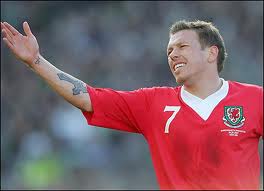
On 13 June 1979, future Wales captain and famously volatile striker Craig Bellamy was born in Cardiff. He has spent the majority of his career in England, with brief loan spells in Scotland and Wales.

Bellamy began his professional career in 1996 with Norwich City and established himself as a regular first-teamer by his second season. But after 32 goals in 84 league appearances, he drew substantial interest from other clubs, eventually moving to Coventry City in 2000 for a transfer fee of £6.5 million. Then, when Coventry were relegated at the end of his first season there, he moved on Newcastle.

He did well on the pitch at Newcastle, scoring 14 times in his first season, but he fell out with members of the coaching staff and several players, including his strike partner Alan Shearer. Manager Graeme Souness sent him out to Celtic on loan for the second half of the 2004-05 season. Afterward, he spent time with Blackburn Rovers (2005-06), Liverpool (2006-07), West Ham (2007-09), and Manchester City (2009-10) before moving to Cardiff City on loan in August 2010.

Along the way, Bellamy was accused of assault in four separate instances, though never convicted. Most recently, he was arrested in Cardiff in January 2011 for an alleged assault on two men.

Bellamy debuted for Wales in 1998 and rose to captain the team in 2006. To date, he has made 62 national team appearances and has scored 18 goals to place fifth on the list of the Wales national team's top scorers.

Tuesday, April 26, 2011

27 April 1974 - Law Sentences United To Relegation

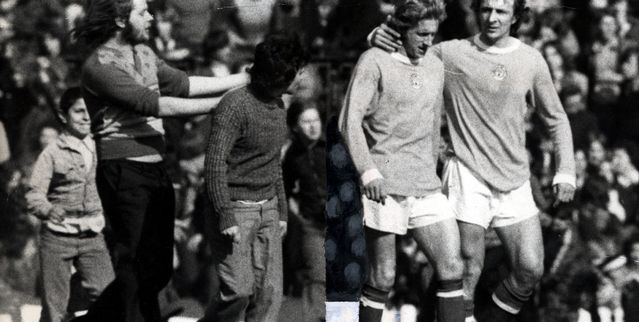
On 27 April 1974, Manchester City defeated Manchester United 0-1 at Old Trafford, securing United's relegation to the Second Division. The match's lone goal was scored by former European Footballer of the Year Denis Law, who had spent the previous eleven seasons with United before moving to City on a free transfer in the summer of 1973.

United entered the match in 21st position on 32 points, three points behind Birmingham City, who were sitting above the drop in 19th place. At that time, wins earned two points each and United, with two matches left to play, had a match in hand. Thus, in order for United to avoid relegation, they needed at least a draw against City and a Birmingham loss.

With less than 10 minutes to play, the match was scoreless. Then City pressed forward and the ball found its way into the United box where Law instinctively backheeled it into the net. Law's teammates rushed over to congratulate him, but he refused to celebrate, realizing that he had just sealed the fate of the club he loved. United's supporters invaded the pitch and the match was stopped. The scoreline held, though, 0-1 to City.

As it turned out, Birmingham won their last match, so United would have gone down even if they had beaten City. Nevertheless, the goal is remembered as the one that sent them down to Division Two. In any event, they didn't stay down long, earning promotion back to the top flight at the first opportunity.

Sunday, February 13, 2011

14 February 2009 - James Breaks The Speed Record

On 14 February 2009, Portsmouth goalkeeper David James made his Premier League record 536th appearance in a 2-0 win over Manchester City.

James started his career in 1989 with Watford, who were then in the Second Division. After three seasons there, he moved to the Premier League in 1992, signing with Liverpool for £1.25 million. He had a rough start at Anfield and was dropped from the starting line-up in his second season after the Reds conceded 20 goals in their first 11 matches. But he regained the starting job the following season and stayed there through the 1998-99 season, making 194 league appearances.

He then moved to Aston Villa (1999-2001) and West Ham (2001-04). West Ham were relegated for the 2003-04 season, breaking James's streak of top-flight appearances at 325. But he moved back to the Premiership in January 2004, transferring to Manchester City.

In August 2006, after three seasons with City, James moved again, this time to Portsmouth. In his first year there, he kept a record 142nd Premier League clean sheet, beating the earlier record set by David Seaman. Then, after winning the 2008 FA Cup with Pompey, he made his record appearance, beating the former record held by Welsh midfielder Gary Speed.

James left Portsmouth in July 2010 for Bristol City, who play in England's second tier, the Championship. That ended his run of Premier League appearances, which currently stands at 573.

Wednesday, September 1, 2010

2 September 2008 - Robinho Turns Blue

On 2 September 2008, Manchester City announced the signing of Brazilian striker Robinho for a then-British record fee of £32.5 million. He was the club's first signing since reaching an agreement to accept the Abu Dhabi United Group as their new owners.

Robinho began his professional career in 2002 with Santos and received his first senior cap for Brazil the following year. In 2005, he moved to Real Madrid, helping them to back-to-back La Liga titles in 2007 and 2008. In his three seasons there, he made 132 appearances in all competitions, scoring 35 goals. By the summer of 2008, however, he had fallen out with club owner Ramon Calderon, who had tried to use Robinho as part of a deal to bring Cristiano Ronaldo to the club, and demanded a transfer.

Initial speculation focused on Chelsea as Robinho's likely destination, as one of the few clubs who could afford him. But the deep pockets of Manchester City's new owners allowed them to make a shock move for Robinho on the last day of the transfer window. In addition to the record fee, the four-year deal included wages of £160,000 per week.

In his first season at Eastlands, he made 41 appearances, scoring 15 goals, while City finished in a disappointing 10th place. Injuries limited his effectiveness in his second season and he scored only a single goal in 12 appearances before returning to Santos on loan for the remainder of the season. On 31 August 2010, he moved to AC Milan for an undisclosed fee.

Monday, August 9, 2010

10 August 2003 - City Breaks New Ground

On 10 August 2003, Manchester City played their first match at the new City of Manchester Stadium, beating Barcelona 2-1.

Nicknamed "Eastlands," the stadium was originally built for the 2002 Commonwealth Games and cost £110 million to build, plus another £30 million to convert it to a football-specific facility. With a capacity of 47,726, it is substantially larger than City's previous Maine Road ground, which was built in 1923 and seated only 35,150 (though it held a record crowd of 84,569 in 1934 when the terraces were still in use).

To celebrate the move, City brought Barcelona in for a high-profile friendly and took a first-half lead with a 38th-minute goal from striker Nicolas Anelka (pictured), starting his second season with the Blues. A strike from Barça's Javier Saviola leveled the teams in the 58th minute, but City's new signing Trevor Sinclair sent a header in off the post nine minutes later to retake the lead. Andrés Iniesta almost had a late equalizer, but his shot was cleared off the line by defender Richard Dunne.

Tuesday, May 4, 2010

5 May 1956 - Trautmann Puts His Neck On The Line

On 5 May 1956, Manchester City defeated Birmingham City 3-1 in the FA Cup Final before a crowd of over 100,000 at London's Wembley Stadium. It was a remarkable win, considering that the Man City goalkeeper, Bert Trautmann (pictured, center), played the last seventeen minutes with a broken neck.

Although it was Manchester City's second consecutive appearance in the Final, having lost 3-1 to Newcastle the previous year, the English press hailed Birmingham as favorites due to a strong run up to the Final that saw them concede only two goals while scoring eighteen. Man City, on the other hand, had advanced in every round by a mere one-goal margin. But they had an advantage in Trautmann, whom the Football Writers' Association had recently named Footballer of the Year.

Manchester City pressured the Birmingham goal from the opening kickoff, resulting in a third-minute strike from forward Joe Hayes that gave them a 1-0 lead. Birmingham quickly equalized, however, when a 15th-minute shot ricocheted off a Man City defender to wrong-foot Trautmann, then landed in the path of forward Noel Kinsey, who slotted it home.

The two sides were evenly matched to the hour mark, when Man City took advantage of Birmingham's defensive lapses to score two quick goals from forwards Bobby Johnstone (62') and Jack Dyson (64'). Birmingham attacked the Man City goal with renewed fervor when, in the 73rd minute, forward Peter Murphy collided with Trautmann. Murphy's knee rammed into Trautmann's neck, knocking the keeper unconscious.

The rules at the time did not alow for substitutes, so after Trautmann recovered, he insisted on staying on the pitch as Manchester City complete the 3-1 win. Three days later, Trautmann's neck still hurt, so he went to a doctor who confirmed that he had dislodged five vertebrae, one of which was broken in two. Trautmann became a folk hero at Manchester City, for whom he played until 1964, making over 500 appearances.

Saturday, May 1, 2010

2 May 1960 - The Clarets Claim The Crown

On 2 May 1960, Burnley defeated Manchester City, 1-2, at Maine Road on the last day of the season. The win vaulted the Clarets from third place to first, securing their second League title.

Burnley has a storied history in English football. The club started initially as a rugby club before switching to association football in 1882, then became one of the founding Football League members in 1888. They spent the next two decades moving between the top two divisions, then settled comfortably into the top flight for a period starting in 1913. They claimed their first major honor in 1915, winning the FA Cup, and finished fourth in the table before World War I stopped League play.

When play resumed in 1919, Burnley picked up where they had left off, finishing second that season. The next season, they won their first League title thanks to a record-setting run of 30 unbeaten matches. Despite a third place finish in 1921-22, the Clarets started a steady decline that resulted in their relegation in 1930. They returned to the First Division in 1947, finishing third that season behind Arsenal and Manchester United, then strung together a series of mid-table finishes, including a couple of years where they finished sixth, before their title-winning 1959-60 campaign.

That year, they consistently challenged for the title, but spent most of the season behind Wolverhampton and Tottenham, which is where they were on the final day. Wolves were in first on 54 points, with Spurs and Burnley both one point behind (Spurs were in second thanks to a better goal average), but Burnley still had a game in hand. By beating City on the final day, Burnley jumped the teams in front of them to steal the title.

Burnley remained in the top flight until 1971 and has since moved among the top three divisions. They are currently playing in the top flight once more, having earned promotion to the Premier League in 2009, but have struggled this season and are sitting in the relegation zone once again.

Tuesday, April 13, 2010

14 April 1912 - The Saints Go Marching In

On 14 April 1912, a group of footballers in the Brazilian city of Santos, located in the state of São Paolo, founded a new football club which they named Santos FC. The club credits their formation to three men in particular - Raimundo Marques, Mário Ferraz de Campos, and Argemiro de Souza Júnior. But they are best known as the 17-year home of Pelé.

Santos enjoyed some modest early success, winning a handful of regional competitions starting with the Santos City Championship in 1913 and 1915, but they reached their highest heights only after the arrival of the then 15-year old Pelé in 1956. Within a few short years, Santos were established as a national power, winning five consecutive Brazilian Cups from 1961 through 1965. During that period, they also twice won South America's Copa Libertadores (1962 and 1963).

After Pelé's departure in 1974 for the New York Cosmos, Santos went into decline. They enjoyed a resurgence in the early 2000s, however, winning the Brazilian top flight in 2002 and 2004 with help from their skillful young forward Robinho.

Robinho left in 2005 for Real Madrid, triggering another dip in Santos' fortunes. They finished mid-table in 2009, finishing 12th out of 20 teams, but will enter the 2010 season next month with renewed optimism, having signed Robinho back on loan from Manchester City, whom he joined in 2008.

Tuesday, March 30, 2010

31 March 2001 - The End Of Rocky's Road

On 31 March 2001, 33-year old midfielder David "Rocky" Rocastle, who had played for Arsenal, Leeds United, Manchester City, and Chelsea, died from complications related to non-Hodgkin's lymphoma.

Born in 1967, Rocastle started his career with Arsenal's youth squad in 1983, then joined the senior side from 1985 to 1992. He was a star for the Gunners, making 218 League appearances and scoring 24 goals. In that time, Arsenal won one League Cup (1987) and two League titles (1989, 1991). But near the end of his time at Highbury, injuries began to impact his game and he transferred to Leeds United in the summer of 1992 for £2 million, a Leeds record at the time.

His playing time at Elland Road was limited by a combination of factors, including injury and competition from other players, including Gordon Strachan, the man he'd been brought in to replace. In December 1993, Rocastle moved again, this time to Manchester City, but once more failed to make an impact. At the end of the 1992-93 season, he returned to London, this time with Chelsea.

He stuck with Chelsea for four seasons, but never recovered the form or fitness he had during his previous spell in London with Arsenal. He spent 1997 out on loan to Norwich City and Hull City, then returned to Chelsea's reserve team. After leaving Chelsea in 1998, he briefly joined Malaysian side Sabah FA, but injuries forced his retirement in December 1999.

In February 2001, Rocastle announced that he had contracted non-Hodgkin's lymphoma, a form of cancer that affects the immune system. Despite aggressive chemotherapy, he died on 31 March.

Arsenal paid tribute to Rocastle by naming their new youth team indoor training facility after him. They also included him as one of 16 former Arsenal players to have their images painted on the sides of the new Emirates Stadium.


Tuesday, January 26, 2010

27 January 2001 - Damarcus' Debut

On 27 January 2001, speedy 18-year old midfielder Damarcus Beasley collected his first cap for the United States senior team in a 2-1 friendly win over China played in Oakland, California. Known primarily for his pace on the left wing, Beasley has also shown versatility, playing at forward and left back for the national team.

Beasley had previously been a standout for the U-17s, who reached the semifinals of the 1999 U-17 World Championship, with Beasley earning the Silver Ball award as the tournament's second most valuable player.

He was key player for the US in both the 2002 and 2006 World Cups. In the latter, he provided the assist for the only goal scored by the Americans, a 43rd-minute equalizer by Clint Dempsey in the final group stage match against Ghana. Beasley put the ball in the back of the net against Italy, but the goal was disallowed after the referee determined that forward Brian McBride had screened the Italian goalkeeper from an offside position.

To date, Beasley has made 89 appearances for the national team, scoring 17 goals. He currently plays in Scotland for Rangers, after joining the Glasgow side in 2007. He previously played for the Chicago Fire (2000-04), PSV Eindhoven (2004-07), and Manchester City (on loan from PSV, 2006-07).

[2012 Update: Beasley left Rangers for Hannover 96 in 2010, then moved to Mexico to play for Puebla, his current club, one year later.]

Saturday, January 16, 2010

17 January 1948 - Even Oasis Never Drew That Large A Crowd There

On 17 January 1948, a League-record 83,260 people watched Manchester United draw 1-1 with Arsenal. Although it was considered a home match for United, it was held at Manchester City's Maine Road ground (right), because Old Trafford was undergoing repairs for damage caused during World War II.

At the time, United were in fourth place in the First Division table, nine points behind league leaders Arsenal (who had won the season's prior contest at Highbury, 2-1). The Gunners would go on to win the league, while United would claim that season's FA Cup, as well as their second consecutive second-place league finish.

While the 17 January 1948 attendance set the highest total for a league match, it is second to the overall English record of 84,569, reached at Maine Road for a 6th round FA Cup match between Manchester City and Stoke City on 3 March 1934.

At the end of the 2002-03 season, Manchester City moved out of Maine Road to the new City of Manchester Stadium. By that time, Maine Road had been converted to an all-seater, eliminating the terraces and reducuing its capacity to 35,150.

Wednesday, November 11, 2009

12 November 1881 - Manchester's Heathens and Saints

On 12 November 1881, Newton Heath FC defeated hosts West Gorton (St. Mark's) FC, 3-0, in a friendly. It was the first Manchester derby, as the Heathens later became known as Manchester United and the Saints later changed their name to Manchester City. The Ashton Reporter covered the match, calling it "a pleasant game."

Since that first match, played at the invitation of West Gorton, there have been 152 competitive matches between the two teams. United currently have the advantage with 62 wins to City's 41 (there have been 49 draws). The derby's top scorers are City's Joe Hayes and Francis Lee, tied at 10 goals each. United's top derby scorer is Bobby Charlton with 9.

A number of players have taken the pitch for both City and United, including Denis Law, Peter Schmeichel, and, most recently, Carlos Tevez.

United are currently on a three-match derby win streak. City's last derby win was on 2 February 2008, which completed a City double over United that season.

Saturday, October 3, 2009

4 October 1933 - Busby's Brief International Career

On 4 October 1933, wing half Matt Busby debuted for Scotland in a 3-2 loss to Wales at Ninian Park in the British Home Championship. He played for Scotland seven more times during World War II, but the 1933 appearance was his only official one for the Scottish national side.

Busby was in the midst of an impressive playing career for Manchester City, for whom he made a total of 229 appearances between 1928 and 1936, scoring 14 goals and winning the 1935 FA Cup. (The photo to the right shows Busby meeting the future King George VI at the 1933 FA Cup Final.)

In 1936, he transferred to Liverpool, where he played until 1939, making 122 appearances. His playing career officially ended with the outbreak of World War II as he, along with many other Liverpool players, signed up for military service with the King's Liverpool Regiment.

Wales went on to win the 1933-34 British Home Championship with a 2-1 win over England and a 1-1 draw with Ireland. Scotland finished at the bottom of the table, losing all three of their matches.

After the war, Busby started a successful management career with Manchester United, where he stayed from 1945 to 1969, and then from 1970-71. He also briefly managed a unified British national side in 1948 and the Scottish national team in 1958.

Tuesday, September 29, 2009

30 September 2006 - This Time, Barton Shows His Backside Figuratively AND Literally

On 30 September 2006, Manchester City drew with Everton 1-1 before a crowd of 38,250 at Goodison Park with an equalizer from defender Micah Richards in the fourth minute of stoppage time. City midfielder Joey Barton celebrated the draw by dropping his shorts and exposing his bare bottom to the home fans.

Barton, who played youth football for City, signed with the club as a professional in 2002 and, by 2006, was already in the process of developing a reputation for trouble. At the City Christmas Party in 2004, youth player Jamie Tandy--himself no stranger to trouble--attempted to set fire to Barton's shirt. Barton responded by sticking a lit cigar in Tandy's eye. Although Tandy's injuries were limited to a burnt eyelid, City issued Barton a club-record fine of £60,000.

In the summer of 2005, City were participating in a preseason tournament in Thailand when a 15-year old Everton supporter verbally insulted Barton and kicked him in the shin. Barton responded by attacking the boy and had to be pulled away by teammate Richard Dunne. Afterward, City manager Stuart Pearce ordered Barton to take anger management classes and also fined him £120,000.

By contrast, Barton's backside-baring earned him a paltry £2,000 fine and a caution from the Football Association.

Barton was not through making headlines for off-the-pitch behavior, however. On 27 December 2007, he was caught on video fighting on the streets of Liverpool. He attacked a 16-year old boy, breaking several teeth, and punched another man at least 20 times. He was sentenced to six months in jail, but was released after spending only two months behind bars.

Barton currently plays for Newcastle in the Championship, England's second tier.

[Note: The clip below shows the incident in question and may be considered NSFW.]


Wednesday, September 2, 2009

3 September 1906 - Now At 103 Years And Counting

On 3 September 1906, Everton pummeled Manchester City 9-1 at Goodison Park, setting a record scoreline for both sides.

It was only the second match of the season in Division One and City must have hoped for an improvement over their 1-4 home loss to Arsenal in the first week. Everton, meanwhile, had drawn 2-2 away to Middlesbrough in their first match, thus giving no indication of the juggernaut side that was to face City on the second matchday.

Still, Everton were a known quality side as the reigning FA Cup champions, having defeated Newcastle 1-0 in April 1906 (Everton's Cup-winning side is pictured). And the win over City was no fluke for the Toffees, who went on to finish in Division One's third place. City ended the season fourth from the bottom.

The 9-1 result remains Everton's largest margin of victory in the League and City's most lopsided League defeat.