Showing posts with label Tottenham Hotspur F.C.. Show all posts

Monday, February 20, 2012

21 February 2008 - Gazza's Days Get Darker

On 21 February 2008, former England star midfielder Paul Gascoigne's tragic battle with alcoholism and depression resulted in his compulsory admission to a mental hospital for treatment. Unfortunately for all involved, it did little good and he continues to struggle with his problems.

Gascoigne, popularly known as "Gazza," enjoyed a remarkable career that started in 1985 with Newcastle and included spells at Tottenham (1988-92), Lazio (1992-95), and Rangers (1995-98), among others. Meanwhile, he was capped 57 times by England between 1988 and 1998, including a standout performance in the 1990 World Cup that sparked "Gazzamania" back in England.

But throughout, he struggled in his personal life with addiction and other issues, including depression and bipolar disorder. His problems grew worse after his retirement in 2004, followed by a short and unsuccessful spell as manager of Kettering Town that ended with his sacking in 2005 after only 39 days in charge. He claimed later that he was drinking up to four bottles of whisky and vodka per day.

In February 2008, police were called to the Newcastle hotel where he was staying while recovering from a hip operation. After he threatened to harm himself, he was taken into custody and compelled to enter a mental health facility. But by the end of the year, he was again deep into his alcoholism, reportedly drinking up to 30 cans of beer per day.

After promising signs of recovery in 2009, Gascoigne again relapsed in 2010, culminating in two separate October arrests for drunk driving and possession of cocaine.

Tuesday, January 3, 2012

4 January 2005 - Mendes Denied

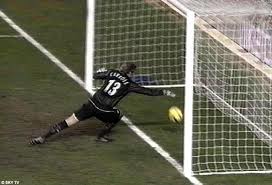
On 4 January 2005, Tottenham were denied three points when a Pedro Mendes goal against Manchester United wasn't given, despite the ball being a full meter over the line. The match ended as a scoreless draw.

The two teams met at Old Trafford with Spurs having won six of their previous seven to rise from 15th in the league to 7th. United were on a similar streak, holding down 3rd place after winning eight of the last nine matches. The hosts controlled most of the match, enjoying the better of possession and taking a handful of decent shots, but were repeatedly denied by Spurs keeper Paul Robinson.

Spurs had a few chances of their own, but the day's most memorable moment came in the 89th minute. Mendes, seeing United keeper Roy Carroll off his line, fired a shot from near the midfield line. Carroll raced back and appeared to catch the ball easily, but dropped it. It bounced into the goal, crossing well over the line, as Carroll scrambled to knock it away. Unfortuately for the visitors, neither referee Mark Clattenburg nor linesman Ray Lewis saw the ball clear the line, so neither awarded the goal and the match ended 0-0.

The missed goal sparked cries for the use of goal-line technology, but FIFA has so far resisted any such move. And, ultimately, it had little impact on either club, as United finished in 3rd separated by several points on both sides and Spurs ended up in 9th, though the extra two points would have pushed them up to 8th.

Wednesday, December 21, 2011

22 December 2007 - Bendtner Rises To The Occasion

On 22 December 2007, Arsenal forward Nicklas Bendtner set an English record by scoring only 1.8 seconds after coming on as a late substitute against Tottenham Hotspur.

Although Bendtner had signed with the Gunners back in 2005, he had spent the 2006-07 season on loan at Birmingham and was eager to establish a place in the Arsenal first team. By December, he had scored crucial goals in the League Cup and the Champions League, but had not yet opened his Premier League account.

His moment finally came in the North London derby, as Arsenal hosted Tottenham. With Bendtner on the bench, Arsenal took a 1-0 lead with a goal from Emmanuel Adebayor (48'), but Dimitar Berbatov (66') drew Spurs level. The visitors had a chance to go ahead in the 72nd minute after the referee awarded a penalty for a Kolo Toure foul on Berbatov, but Arsenal goalkeeper Manuel Almunia saved Robbie Keane's tame attempt.

Two minutes later, with the match level at 1-1, Arsene Wenger made an attacking change, sending Bendtner on for midfielder Emmanuel Eboue. The Danish striker immediately positioned himself near the far post for a Cesc Fabregas corner kick, then charged into the goalmouth to head the ball past goalkeeper Paul Robinson. It was Bendtner's first touch of the ball, coming only 1.8 seconds after he entered the match, and proved to be the game winner.

Monday, November 21, 2011

22 November 2009 - That Must've Been One Heck Of A Half-Time Talk

On 22 November 2009, Tottenham Hotspur recorded their record Premier League victory, beating Wigan 9-1 with five goals from striker Jermain Defoe.

Nobody would have predicted that score at half time. After going up 1-0 with a 9th-minute header from Peter Crouch, Spurs seemed to lose focus and created few other chances in the first half. As manager Harry Redknapp said later, "they needed reminding at the break."

Whatever he said to remind them must have worked, as the goals began to flow soon after the restart. Defoe netted his first of the day in the 51st minute, followed by his second just three minutes later, and his third just four minutes after that. Then, after a goal from Aaron Lennon (64'), Defoe added two more (69', 87'). Spurs finished the scoring with late goals from David Bentley (88') and Niko Kranjčar (94'). Meanwhile, Wigan's lone goal came from Paul Scharner in the 57th minute.

It was Tottenham's biggest margin of victory in a top-flight match and pushed them back into fourth place, behind Chelsea, Manchester United, and Arsenal, which is how the final table appeared. Defoe's haul made him only the third player to score five in a Premier League match (after Alan Shearer and Andy Cole).

Thursday, November 3, 2011

4 November 1933 - Don't These Things Usually Go In The Other Direction?

On 4 November 1933, winger Alf Day earned his first (and last) cap for Wales, despite never having made a league appearance for his club.

Born in the Welsh town of Ebbw Vale in 1907, Day began his career with non-league sides Cheshunt and Northfleet United before moving to Tottenham in 1931. By 1933, he was toiling in the Spurs reserves when the club's secretary, Arthur Turner, received a call from Ted Robbins, his counterpart at the Football Association of Wales. Robbins asked Turner if he could recommend anyone to help fill out a depleted Welsh side for an upcoming match against Northern Ireland.

Turner recommended Day despite the fact that the 26-year old had yet to break into the Spurs first team. His word was good enough for Robbins, though, and he called Day up as a starter for the match. It ended as a 1-1 draw.

Day remained with Spurs until 1936, then spent time with Millwall, Southampton, Tranmere Rovers, and Swindon Town before World War II interrupted his career in 1940. He continued to play unofficially for Swindon during the war, but retired before league play resumed.

Tuesday, August 2, 2011

3 August 1952 - Singer, Actor, Spurs Superstar

On 3 August 1952, future World Cup winner and Tottenham Hotspur Hall-of-Famer Osvaldo "Ossie" Ardiles was born in Bell Ville, Argentina.

The midfielder made his professional debut in 1973 for Argentinian club Instituto Atlético Central Córdoba and he earned his first international cap for Argentina's senior side that same year. Five years and two clubs later (Belgrano, 1974, and Huracán, 1975-78) he was a regular for the national team, starting in every match but one of Argentina's World Cup-winning campaign.

After the 1978 World Cup, he moved to Tottenham where he quickly became a fan favorite along with his fellow Argentinian teammate Ricardo Villa. The central midfield pair brought success to Spurs, helping them win back-to-back FA Cups in 1981 and 1982 (during that time, Ardiles also co-starred with Sylvester Stallone, Michael Caine, and Pelé in the 1981 film Victory and recorded the single "Ossie's Dream" with Chas & Dave in 1981). Villa left in 1983, but Ardiles remained and went on to win the 1984 UEFA Cup with Tottenham. He left Spurs in 1988, but returned to manage the club briefly from 1993 to 1994.

In 2008, he and Villa were jointly inducted into Tottenham's Hall of Fame.

Thursday, July 7, 2011

8 July 1980 - Ireland's Lucky Striker

On 8 July 1980, future Tottenham Hotspur striker and all-time Republic of Ireland scoring leader Robbie Keane was born in Dublin.

Keane began his professional career in 1997 with Wolverhampton and scored twice on his debut for the club. After only two seasons there, he moved to Coventry City in 1999 for £6 million, a British record at the time for a teenager, and again notched a brace on his club debut. He stayed with Coventry for only a single season and spent the next three seasons with three different clubs: Inter (where he made only 6 appearances in the 2000-01 season), then Leeds United (where he played from 2000-02), and Tottenham.

He enjoyed relative stability at Tottenham, playing there for a total of eight seasons from 2002 to 2011, broken by short spells at Liverpool (19 appearances in the 2008-09 season), Celtic (16 appearances in the 2009-10 season), and West Ham (9 appearances in the 2010-11 season). Over the course of his club career, he has scored 210 goals in 549 appearances.

In 1998, while still with Wolves, Keane earned his first cap for Ireland. He has since played for them a total of 108 times. In September 2004, he scored his 21st goal for Ireland to match the record set by Niall Quinn, then passed it with a brace the next month. His current tally stands at 51 after he scored both goals in Ireland's 2-0 win over Macedonia in a Euro 2012 qualifier played in June 2011.

Thursday, May 5, 2011

6 May 1961 - Spurs Do The Double

On 6 May 1961, Tottenham Hotspur completed their Double by winning the FA Cup with a 2-0 victory over Leicester City. Spurs were the first team to win the FA Cup and the League in the same season since Aston Villa did it in 1897.

Tottenham had already won the league in a season that saw them hold onto the top spot from the first week to the last. They had endured only seven losses all season, but one of those came at the hands of Leicester City, who won 2-3 at White Hart Lane in the first week of February.

Playing before a crowd of 100,000 at Wembley, Leicester suffered an early setback with an injury to right back Len Chalmers (who remained on the pitch in diminished capacity until the 80th minute). They nonetheless maintained their composure and held the dynamic Spurs attack in check for 65 minutes. Then, in the 66th minute, Spurs winger Terry Dyson sent the ball in for forward Bobby Smith, who powered the ball past keeper Gordon Banks. Nine minutes later, the pair connected again, with Smith providing the assist for Dyson's header.

It was the third FA Cup for Tottenham, who went on to win it again the following season, then four more times for a total of seven.

Sunday, April 24, 2011

25 April 2004 - The Invincibles Take The Title

On 25 April 2004, Arsenal drew 2-2 with Tottenham at White Hart Lane. The point they earned was enough to clinch the Premier League title with four matches remaining.

The Gunners were near the end of an incredible season, having gone undefeated in the league. They started the day on 81 points, nine clear of second-place Chelsea and with a game in hand. Playing before a crowd of 36,097 at the home of their fierce derby rivals, Arsenal never looked in danger of losing the title.

They went ahead after only three minutes, as Thierry Henry recovered the ball from a failed Spurs corner, sped down the pitch and fed it to Dennis Bergkamp. The Dutchman delivered a precise cross for captain Patrick Vieira, who provided the final touch that put the ball into the net. Bergkamp started the attack for Arsenal's second goal in the 35th minute, beating the Tottenham defenders with a through ball to Vieira, who then gave it to Robert Pires for the finish.

Amid constant pressure from Arsenal, Tottenham fought back, cutting the deficit to one with a goal from Jamie Redknapp in the 63rd minute. Then, in stoppage time, Arsenal keeper Jens Lehmann fouled Robbie Keane, who converted the ensuing penalty kick to earn the draw.

The result put Arsenal ten points clear of Chelsea, who had lost that day to Newcastle and had only three games left. Arsenal drew two of their last four, but finished the season undefeated.

Saturday, February 19, 2011

20 February 1940 - Nothing Funny About That Scoring Record

On 20 February 1940, Jimmy Greaves was born in the London's East Ham district. He would go on to become the greatest goalscorer in the history of the English top flight.

He got off to a great start, scoring on his professional debut with Chelsea in 1957. In four seasons at Stamford Bridge, he scored a total of 132 goals in all competitions, making 169 appearances. While there, he twice finished as the First Division's top scorer, including a 41-goal league tally in 1960-61 that remains a club record (as does his all-competition total of 43 the same season).

After a brief unhappy period with AC Milan, he returned to England with Tottenham Hotspur, where he stayed for nine seasons. It was one of Spurs' most successful periods, as they won the 1963 European Cup Winner's Cup and two FA Cups (1962, 1967). During his time with Spurs, Greaves was a member of England's 1966 World Cup-winning side, but was injured in their last group stage match. Because he missed the remainder of the tournament, including the Final, he did not receive a winner's medal at the time. But after an FA campaign, he received his medal in 2009.

After leaving Tottenham, Greaves played briefly for West Ham, making 40 appearances between 1969 and 1971, when he retired. In all, he scored a record 366 goals in 528 English top flight appearances. Afterward, he became a television pundit famous for his catch-phrase, "it's a funny old game."

Wednesday, February 2, 2011

3 February 1960 - Spurs Cruise Over Crewe

On 3 February 1960, Tottenham Hotspur secured their record win, a 13-2 victory over Crewe Alexandra in a Fourth Round FA Cup replay. It is also Crewe's record loss.

The fact that the tie had gone to a replay was surprising, since, at the time of the original match, Crewe were sitting 16th in Division Four--83 places below Spurs, who were at the top of the First Division. But Crewe managed to hold the league leaders to a 2-2 draw on 30 January, forcing a replay at White Hart Lane.

There, the hosts wasted no time in establishing their dominance. By the 30th minute, Spurs had a 6-1 lead which they extended to 10-1 by the break en route to the final score of 13-2. Inside forward Les Allen had the day's highest tally with 5, followed by center forward Bobby Smith (4), winger Cliff Jones (3), and inside forward Tommy Harmer (1).

Unfortunately, Spurs were not as prolific in the next round where they lost to Blackburn, 1-3. They got their reward the following season, however, winning a league and FA Cup double (including another Fourth Round victory over Crewe in the FA Cup by the relatively modest score of 5-1).

Tuesday, January 11, 2011

12 January 2008 - Enough Clubs To Fill A Golf Bag

On 12 January 2008, Nicolas Anelka debuted for Chelsea, his eighth club in 14 years.

His appearance that day against Tottenham was a surprise, even to manager Avram Grant. The forward had signed for Chelsea just the day before and he had not even participated in a training session. But an injury to Claudio Pizarro forced Grant to bring Anelka on in the 58th minute with the Blues up 1-0. Although he didn't score, he quickly made an impact, hitting the bar once and forcing a difficult save from the Spurs keeper as Chelsea won 2-0.

Chelsea had paid £15 million to Bolton for the French forward. Combined with the fees paid for previous transfers, Anelka's various clubs had paid a total of £84.8 million for him, an amount that made him the world's most expensive footballer at the time. (He is currently in second, just behind Cristiano Ronaldo.) In addition to Bolton (2006-08), Anelka had played for PSG (1994-97, 2000-02), Arsenal (1997-99), Real Madrid (1999-2000), Liverpool (2002), Manchester City (2002-04), and Fenerbahçe (2004-06).

Anelka scored only 2 goals for Chelsea in that first season, but has since added over 50 more, including a league-best 19 in his second season.

Sunday, October 24, 2010

25 October 2007 - They Didn't Give Him Much Incentive To Win It, Did They?

On 25 October 2007, manager Martin Jol guided Tottenham Hotspur in their UEFA Cup tilt against Getafe despite being sacked earlier that day.

Jol, who had taken charge of Spurs in November 2004, led them to 9th-place in the final table that season, followed by consecutive 5th-place finishes in 2006 and 2007. But they had a rocky start to the 2007-08 season, with only one win in their first 10 matches. After only two matches, photographers caught Spurs officials meeting in a Spanish hotel with Sevilla manager Juande Ramos, fueling rampant speculation that Jol's departure was imminent.

Prior to the match against Getafe, Daily Mirror reporter John Cross announced that the Spurs board had in fact sacked Jol, but that he would nonetheless take charge of the side one last time. The word circulated throughout the stadium, leading the Spurs supporters to chant "Stand up for Martin Jol." But it was an unhappy curtain call for the Dutchman, as Getafe won 1-2.

Ramos indeed succeeded Jol, but lasted just under one year before getting sacked himself. Jol, meanwhile, moved to Hamburg. After guiding them to a 5th-place finish in 2008, he moved to his current club, Ajax.

Thursday, August 19, 2010

20 August 1960 - Spurs' Journey Of A Thousand Miles Starts Here

On 20 August 1960, Tottenham Hotspur opened their season with a 2-0 win over Everton, starting the journey that would end with a League and FA Cup double.


Playing before a home crowd of 50,393 at White Hart Lane, Spurs - who had finished the previous season in third place, only two points behind League winners Burnley - created a handful of early chances, but were denied by Everton's goalkeeper, Albert Dunlop. The teams were evenly matched and appeared to be headed for a draw when Spurs center forward Bobby Smith was brought down in the Everton box. The referee played the advantage, however, as Tottenham inside forward Les Allen was in a scoring position and his ensuing shot put the hosts up, 1-0.


Two minutes later, Smith doubled the lead with a low header and the game ended 2-0. The win sent Spurs to the top of the table, where they remained for the rest of the season to claim their second League title, ten years after their first. They capped the season with a 2-0 win over Leicester in the FA Cup Final at Wembley.


Friday, May 14, 2010

15 May 1963 - Hot Spurs

On 15 May 1963, Tottenham Hotspur became the first British club to win a European trophy by beating defending champions Atlético Madrid 5-1 in the European Cup Winners' Cup Final. And Spurs were truly a British club - all eleven starters and manager Bill Nicholson were from the Home Countries of England, Scotland, Wales, and Northern Ireland.

As its name implies, the Cup Winner's Cup, which was first played in the 1960-61 season, pitted the various winners of the European domestic cup competitions against each other. Spurs reached the Final with wins over previous finalists Glasgow Rangers in the first round, followed by wins over Czech side Slovan Bratislava and Yugoslavia's OFK Beograd. Atlético's road to the Final was paved with victories over Maltese side Hibernians, Bulgaria's Botev Plovdiv, and Germany's Nuremberg.

Played at Rotterdam's Feyenoord Stadium before a crowd of 49,000, the Final was close for about a half. Tottenham forward Jimmy Greaves scored first in the 16th minute, then his fellow forward John White extended the lead to 2-0 in the 35th minute. The Spanish side pulled one back shortly after the break, when forward Enrique Collar converted a 47th-minute penalty kick, but it was all Spurs after that.

Forward Terry Dyson restored the two-goal advantage with a 67th-minute strike, then both he and Graves completed braces (Greaves 80', Dyson 85') to finish the match 5-1.

Before UEFA discontinued the Cup Winners' Cup after the 1998-99 season, a handful of British clubs followed after Spurs, including West Ham (1965), Manchester City (1970), Chelsea (1971 and 1998), Rangers (1972), Aberdeen (1983), Everton (1985), Manchester United (1991), and Arsenal (1994).

Saturday, May 1, 2010

2 May 1960 - The Clarets Claim The Crown

On 2 May 1960, Burnley defeated Manchester City, 1-2, at Maine Road on the last day of the season. The win vaulted the Clarets from third place to first, securing their second League title.

Burnley has a storied history in English football. The club started initially as a rugby club before switching to association football in 1882, then became one of the founding Football League members in 1888. They spent the next two decades moving between the top two divisions, then settled comfortably into the top flight for a period starting in 1913. They claimed their first major honor in 1915, winning the FA Cup, and finished fourth in the table before World War I stopped League play.

When play resumed in 1919, Burnley picked up where they had left off, finishing second that season. The next season, they won their first League title thanks to a record-setting run of 30 unbeaten matches. Despite a third place finish in 1921-22, the Clarets started a steady decline that resulted in their relegation in 1930. They returned to the First Division in 1947, finishing third that season behind Arsenal and Manchester United, then strung together a series of mid-table finishes, including a couple of years where they finished sixth, before their title-winning 1959-60 campaign.

That year, they consistently challenged for the title, but spent most of the season behind Wolverhampton and Tottenham, which is where they were on the final day. Wolves were in first on 54 points, with Spurs and Burnley both one point behind (Spurs were in second thanks to a better goal average), but Burnley still had a game in hand. By beating City on the final day, Burnley jumped the teams in front of them to steal the title.

Burnley remained in the top flight until 1971 and has since moved among the top three divisions. They are currently playing in the top flight once more, having earned promotion to the Premier League in 2009, but have struggled this season and are sitting in the relegation zone once again.

Thursday, January 21, 2010

22 January 1920 - A Man With Extraordinary Vision

On 22 January 1920, World Cup-winning England manager and apparent psychic Alf Ramsey was born in London.

During his playing career as a right-back with Southampton (1943-49) and Tottenham (1949-55), Ramsey developed a reputation as an intelligent, though not necessarily physically gifted, footballer, earning three caps for England (one of which was the upset loss to the United States in the 1950 World Cup). But he truly revealed the breadth of his genius when he switched to management.

His first post as manager was in 1955 with Ipswich Town, then in the Third Division South. By the end of his second season, he led them to the Second Division, then in 1961 they were promoted to the First Division--the club's first-ever appearance in the top flight. Although most pundits thought they'd drop back at the end of the 1961-62 season, Ramsey and Ipswich defied them all by winning the league that year.

Ramsey's success with Ipswich led to his appoinment as manager of England in 1963. He embraced the challenge and boldy predicted that England would win the 1966 World Cup. He also shook up the system, personally taking responsibility for team selection and other decisions that had previously been handled by an FA committee.

Ramsey proved his value as a manager and a fortune teller when hosts England did, in fact, win the 1966 World Cup with a 4-2 victory over West Germany in the Final. He was unable to replicate his success, however, and after lackluster performances in the 1968 European Championship and 1970 World Cup, Ramsey was sacked when England failed to qualify for the 1974 World Cup.

He served time as pundit himself, then briefly served as manager for Birmingham City (1977-78), before his death from a heart attack in 1999.

Thursday, December 3, 2009

4 December 1965 - Spurs See Red (For The First Time In 37 Years)

On 4 December 1965, Burnley and Tottenham Hotspur drew 1-1 in a league match at Turf Moor. The match was notable for the sending off of Spurs forward Frank Saul, which ended the club's 37-year streak without a dismissal in a league match.

Saul played his youth football for his hometown club of Canvey Island, then signed his first professional contract with Tottenham in 1960, in time to play for the Double-winning side of 1960-61. He stayed at White Hart Lane for eight seasons, scoring 37 goals in 116 league appearances. In 1968, he transferred to Southampton and later played for Queens Park Rangers, Millwall, and Dagenham before retiring in the late 1970s.

Prior to Saul's dismissal, the last Spurs player to be sent off in a league match was full back Cecil Poynton, who was ejected in a 2-0 loss to Stoke on 27 October 1928.

Saturday, October 10, 2009

11 October 1958 - "Now Out Of This Nettle, Danger, Did He Pluck The Flower, Safety."

On 11 October 1958, Tottenham Hotspur defeated Everton 10-4 at White Hart Lane. It was the first match in charge for new manager Bill Nicholson, who had just been appointed that afternoon.

Nicholson got his start with Spurs in 1936 working for the grounds staff. In 1938, he signed a professional contract with them and spent his entire career with the London club, making 214 league appearances before hanging up his boots in 1955.

He joined the Tottenham coaching staff in 1955 and was the first-team coach in 1958 when then-manager Jimmy Anderson was sacked. At the time, Spurs were sixth from bottom of the First Division table. They finished the season at fifth from bottom, but Nicholson eventually turned the club around, winning the Double in 1961.

Nicholson went on to become one of Tottenham's most successful managers, winning two more FA Cups (1962, 1967), two League Cups (1971, 1973), the European Cup Winners' Cup (1963), and the UEFA Cup (1972). He took Spurs to the 1974 UEFA Cup Final, where they lost to Feyenoord, and resigned shortly afterward.

He was inducted into the English Football Hall of Fame in 2003 and passed away the following year.

Nicholson's 10-4 debut victory over Everton was a club record at the time, but was broken the next season when Spurs defeated Crewe Alexandra 13-2 in the FA Cup on 3 February 1960.

Thursday, September 3, 2009

4 September 2007 - Put Another Way, That's 6.25 Ronaldos

On 4 September 2007, Deloitte announced that English transfer spending for the 2007 summer window exceeded £500 million, up from £300 million the previous summer. The figure includes spending for the Premier League and all three levels of the Football League.

Manchester United spent the most at £51 million, with Liverpool a close second at £50 million. Tottenham was a surprising third at £40 million, while newly-promoted Sunderland was fourth at £35 million.

More than half of Manchester United's fees--£30 million--went to Porto in exchange for midfielder Anderson and winger Nani. They also signed midfielder Owen Hargreaves from Bayern Munich for £17 million.

Liverpool's major signing was striker Fernando Torres, whom they prised from Atlético Madrid for an undisclosed fee believed to be over £20 million, making Torres the most expensive signing in England that summer. They also pulled winger Ryan Babel from Ajax for £11.5 million and midfielder Yossi Benayoun from West Ham for £5 million.

Tottenham's most expensive purchase was striker Darren Bent, whom they acquired from Charlton Athletic for £16.5 million. Spurs also brought in midfielder/back Younes Kaboul from Auxerre for £7 million and left back Gareth Bale from Southampton for £5 million.

Sunderland brought keeper Craig Gordon in from Hearts for £9 million, striker Kenwyne Jones from Southampton for £6 million, striker Michael Chopra from Cardiff City for £5 million and midfielder Kieran Richardson from Manchester United for £5.5 million.

The results on the pitch for those four clubs were mixed. United won its second consecutive Premier League title, with Anderson, Nani, and Hargreaves each playing significant roles. Liverpool finished fourth, with Torres contributing 15 League goals.

Spurs, on the other hand, failed in their push for a top-4 finish, ending the season in 11th place. Darren Bent lasted only two season at White Hart Lane before transferring to Sunderland in the summer of 2009 for an initial fee of £10 million, with clauses that could raise the value to £16.5 million.

Sunderland achieved their primary goal of avoiding relegation, finishing 15th, and have remained in the Premier League since.