Showing posts with label Wolverhampton Wanderers F.C.. Show all posts

Sunday, January 1, 2012

2 January 1965 - A True Young Gunner

On 2 January 1965, Arsenal forward John Radford became the club's youngest player to score a hat-trick when he put three past Wolves just under two months short of his 18th birthday.

Radford came up through the Arsenal youth system, joining them in 1962 at the age of 15. Two years later, he signed a professional contract, then made his first-team debut that March. It was his only appearance of the 1963-64 season, but he featured more the following season, leading up to his record-breaking performance against Wolves at the age of 17 years and 315 days.

He was a key component of the club's Double-winning 1970-71 season, scoring 21 league goals as Arsenal claimed the title and providing the assists for both goals in their 2-1 win over Liverpool in that season's FA Cup final. He also helped them win the 1969-70 Inter-Cities Fairs Cup.

Radford remained with Arsenal until 1976, having scored 149 goals--enough to take second place on the club's all-time scorer list at the time, behind Cliff Bastin (178), though they have since been overtaken by Ian Wright (185) and Thierry Henry (226).

Thursday, July 7, 2011

8 July 1980 - Ireland's Lucky Striker

On 8 July 1980, future Tottenham Hotspur striker and all-time Republic of Ireland scoring leader Robbie Keane was born in Dublin.

Keane began his professional career in 1997 with Wolverhampton and scored twice on his debut for the club. After only two seasons there, he moved to Coventry City in 1999 for £6 million, a British record at the time for a teenager, and again notched a brace on his club debut. He stayed with Coventry for only a single season and spent the next three seasons with three different clubs: Inter (where he made only 6 appearances in the 2000-01 season), then Leeds United (where he played from 2000-02), and Tottenham.

He enjoyed relative stability at Tottenham, playing there for a total of eight seasons from 2002 to 2011, broken by short spells at Liverpool (19 appearances in the 2008-09 season), Celtic (16 appearances in the 2009-10 season), and West Ham (9 appearances in the 2010-11 season). Over the course of his club career, he has scored 210 goals in 549 appearances.

In 1998, while still with Wolves, Keane earned his first cap for Ireland. He has since played for them a total of 108 times. In September 2004, he scored his 21st goal for Ireland to match the record set by Niall Quinn, then passed it with a brace the next month. His current tally stands at 51 after he scored both goals in Ireland's 2-0 win over Macedonia in a Euro 2012 qualifier played in June 2011.

Thursday, March 24, 2011

25 March 1939 - Not The Teams You'd Expect For The Record, Are They?

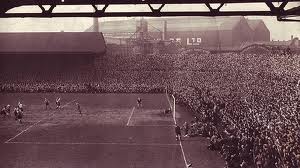
On 25 March 1939, Manchester United's Old Trafford ground held its largest-ever crowd. And Manchester United weren't playing.

Designed by famed architect Archibald Leitch and completed in 1909, the stadium was originally named United Football Ground, but was renamed to Old Trafford in 1936. With an original terraced capacity of just under 80,000, it was one of England's largest grounds and hosted some prominent matches, including English internationals and FA Cup Finals.

In 1939, it served as the venue for one of the FA Cup semi-finals. A stadium-record crowd of 76,962 people turned out to watch Wolverhampton Wanderers beat Grimsby Town 5-0. The victory sent Wanderers to the Final at Wembley, where they lost to Portsmouth.

In the early 1990s, the club converted the stadium to an all-seater, following the recommendation of the Taylor Report following the 1989 Hillsborough Disaster. The capacity dropped at that point to around 44,000. Subsequent additions, however, have increased the stadium close to its pre-Taylor Report levels and it currently boasts a capacity of 75,957.

Wednesday, December 1, 2010

2 December 2003 - It's About The Easiest One He'll Ever Score, Too

On 2 December 2003, midfielder Cesc Fabregas scored a late goal in Arsenal's 5-1 romp over Wolves in the League Cup. At 16 years and 212 days old, he became the youngest person to score for Arsenal in a first-team match.

Fabregas had signed with the Gunners the previous September. By October, he had already set a club record when he played against Rotherham United in a League Cup match, becoming the youngest player to make a first-team appearance for Arsenal.

The match against Wolves was only his second appearance for the club. Played at Highbury before a crowd of 28,161, the hosts went up 4-0 with goals from Jeremie Aliadiere (24', 71'), Nwankwo Kanu (68'), and Sylvain Wiltord (79') before Wolverhampton midfielder Alex Rae pulled one back with a powerful goal in the 80th minute. But the 88th-minute tap-in from Fabregas restored the cushion for the final score.

It was his only goal of the season, and one of only three appearances for Arsenal that year. He has since gone on to score a total of 53 goals in 280 appearances and has captained the side since November 2008.

Monday, September 6, 2010

7 September 1999 - It's All Downhill From Here

On 7 September 1999, forward Ade Akinbiyi became Division Two's then-record signing when he moved from Bristol City to Division One Wolverhampton Wanderers.

Wolves, who were making a promotion push, paid £3.5 million for the England-born Nigerian international, which was a club record at the time (and remains the highest fee ever received by Bristol City). Akinbiyi had scored 21 goals the previous season and the club hoped he would fill the shoes of striker Robbie Keane, who had left that summer for Coventry City.

Akinbiyi performed well, scoring 16 goals for Wolverhampton in the 1999-2000 season, but they just missed the Division Two playoffs, finishing in seventh place, two points behind the last playoff position. At the end of the season, he moved to Leicester City for £5.5 million, but failed to bring his scoring touch. He recorded only 11 goals in 58 League appearances for the Foxes, resulting in the Sun calling him "The League's Worst Striker."

He left Leicester in 2002 and played for a number of clubs in England and the United States. He most recently played for Notts County, but was released in May 2010.

Saturday, May 1, 2010

2 May 1960 - The Clarets Claim The Crown

On 2 May 1960, Burnley defeated Manchester City, 1-2, at Maine Road on the last day of the season. The win vaulted the Clarets from third place to first, securing their second League title.

Burnley has a storied history in English football. The club started initially as a rugby club before switching to association football in 1882, then became one of the founding Football League members in 1888. They spent the next two decades moving between the top two divisions, then settled comfortably into the top flight for a period starting in 1913. They claimed their first major honor in 1915, winning the FA Cup, and finished fourth in the table before World War I stopped League play.

When play resumed in 1919, Burnley picked up where they had left off, finishing second that season. The next season, they won their first League title thanks to a record-setting run of 30 unbeaten matches. Despite a third place finish in 1921-22, the Clarets started a steady decline that resulted in their relegation in 1930. They returned to the First Division in 1947, finishing third that season behind Arsenal and Manchester United, then strung together a series of mid-table finishes, including a couple of years where they finished sixth, before their title-winning 1959-60 campaign.

That year, they consistently challenged for the title, but spent most of the season behind Wolverhampton and Tottenham, which is where they were on the final day. Wolves were in first on 54 points, with Spurs and Burnley both one point behind (Spurs were in second thanks to a better goal average), but Burnley still had a game in hand. By beating City on the final day, Burnley jumped the teams in front of them to steal the title.

Burnley remained in the top flight until 1971 and has since moved among the top three divisions. They are currently playing in the top flight once more, having earned promotion to the Premier League in 2009, but have struggled this season and are sitting in the relegation zone once again.

Saturday, March 27, 2010

28 March 1903 - Ireland's Good Old Goodall

On 28 March 1903, center-half Archie Goodall (pictured) scored the opening goal in Ireland's 2-0 victory over Wales in the 1903 British Home Championship. Goodall was 38 years and 283 days old, making him the oldest goalscorer in the history of the Irish national team.

Born in Belfast in 1864, Goodall spent his entire club career in England, starting with Preston North End in 1887. After one season in Deepdale and one with Aston Villa, he settled with Derby County for whom he made 380 league appearances (and scored 48 goals) between 1889 and 1903.

He received his first call up for Ireland in March 1899. Prior to that time, the Irish FA had refused to allow the national team to select footballers who were playing in clubs outside Ireland, making Goodall one of the first players based in England to don a shirt for the Irish national team.

Ireland's match against Wales on 28 March 1903 was their last of the tournament. Goodall's goal - the second and last of his international career - helped the Irish finish level on points with England and Scotland and, because there was no provision in the tournament rules to break a tie, the three sides shared the trophy equally. It was the first top finish for Ireland, who would finish as runners-up the following season, then win the title outright in 1914.

Goodall left Derby County in 1903 and spent a season with Plymouth Argyle before moving to Glossop North End as player-manager. After one season there, he moved to Wolverhampton in 1905, but made only seven appearances for Wolves before retiring later that year.

Sunday, January 31, 2010

1 February 1936 - The Floodgates Opened

On 1 February 1936, the sides in the four levels of the English pyramid set a collective League record by scoring (or conceding) a total of 209 goals in a single day. Nine players scored hat-tricks and three players bagged four goals each.

The goals were scored in 44 different matches, for an average of 4.75 goals per match. Highlights included Chester City's 12-0 win over York City and Chesterfield's 5-6 win at Crewe Alexandra, both of which were in Division Three North. In the top flight, Brentford rolled over Wolves 5-0 and West Brom flooded Liverpool 6-1, while the largest margin of victory in Division Two was West Ham's 6-0 win over Bury. The only scoreless League match that day was Aldershot's 0-0 draw with Bristol City in Division Three South.

Division One's last place team Aston Villa delivered the day's biggest upset by beating hosts Derby County, then in second place, by the score of 1-3. The win did little to change Villa's fortunes, however, as they finished second from bottom are were relegated to Division Two.

Monday, September 7, 2009

8 September 1888 - And We're Off!

On 8 September 1888, Aston Villa's Gershom Cox (pictured in back, third from the right) scored the Football League's first goal when he found the net in the 30th minute of Villa's opening-day match against Wolverhampton Wanderers. Unfortunately for Cox and Villa, however, the net was his own.

On the same day, Preston North End captain Fred Dewhurst scored in the 3rd minute against Burnley (a match Preston went on to win 5-2). Athough records from that time are sparse, it is believed that Villa-Wolves kicked off at 3:00 p.m., while the Preston-Burnley match started at 3:50 p.m. So Cox's goal came at 3:30 and Dewhurst's goal came at 3:52.

Fortunately for Cox, his own goal was not the game-winner for Wolves, as Villa's Tom Green scored an equalizer to end the match at 1-1.