Showing posts with label Wales. Show all posts

Wednesday, March 28, 2012

29 March 2000 - (Un)Welcome Home, Wales

On 29 March 2000, Wales played their first match at the new Millenium Stadium in Cardiff. And lost 1-2.

Built on the site of the old national ground, Cardiff Arms Park, construction on the stadium finished in the summer of 1999 at a total cost of £121 million. The Welsh rugby team hosted the first major event there, beating South Africa in a friendly.

The football team's turn came the following spring, as they hosted Finland in a friendly of their own. A crowd of 65,000 showed up for the event, setting a new national team record (though it has since been broken). Unfortunately for the home fans, however, Finnish midfielder Jari Litmanen (pictured, battling Wales' Robbie Savage) scored the opening goal in the 21st minute. Welsh striker Nathan Blake found the back of the net in the 42nd minute, but it was the wrong net, putting the Finns up 0-2.

Ryan Giggs pulled one back in the 60th minute, but that was the last goal of the day and Finland left as 1-2 winners.

Sunday, March 4, 2012

5 March 1892 - They Were Masters Of Time And Space

On 5 March 1892, England played and won two different matches by identical scores of 2-0.

The occasion was that year's British Home Championship, contested among England, Scotland, Ireland, and Wales. The latter two opened the competition with a 1-1 draw a week earlier, then both had their second matches scheduled against England, but on the same day. And in two different locations. So the English sent two different teams.

Wales hosted one team at the Racecourse Ground in Wrexham and fell to goals from Arthur Henfrey and Rupert Sandilands. Meanwhile, England's other team beat Ireland at the Solitude Ground in Belfast with a brace from Harry Daft (pictured). Daft and Henfrey were teammates at Corinthians, while Sandilands played his club ball for Old Westminsters.

Afterward, England got a month-long break before their next match, a 4-1 win over Scotland on 2 April that secured their fifth BHC trophy.

Saturday, February 25, 2012

26 February 1881 - For Wales, It Was Worth The Wait

On 26 February 1881, Wales got their first victory, a one-goal win over England in their eighth match.

Founded five years earlier, the Welsh team had lost their first seven matches, scoring only four goals total while conceding twenty-eight. Their worst loss was a 9-0 defeat to Scotland in 1878. They had played England only twice, losing 1-2 in 1879 and 2-3 in 1880, both times in Wales.

They changed the venue for the next match, meeting England before a crowd of 4,200 at the Alexandria Meadows in Blackburn. At the time, all but three of the Welsh players were with Welsh clubs, with the other three based in England. The hero of the day was John Vaughn, from Welsh club Ruabon Druids, who scored the day's only goal in the 34th minute.

Wales did not have to wait long for their next win, beating Ireland 7-1 two games later. Vaughan, meanwhile, went on to earn a total of eleven caps, but scored only one more goal.

Tuesday, December 13, 2011

14 December 1994 - The Hardman Cometh (To Wales)

On 14 December 1994, 30-year old English midfielder Vinnie Jones received his first international call-up--for Wales.

Jones, who was born the English town in Watford, had made his reputation as the leader of the Wimbledon FC "Crazy Gang" that won the 1988 FA Cup over Liverpool. Self-proclaimed as one of football's hardest men, he lived up to the billing by playing with a reckless abandon and earning a slew of red cards along the way. While at Wimbledon, he committed two of his most infamous acts--inflicting a 1986 knee injury on Spurs defender Gary Stevens that eventually ended his career and grabbing Newcastle midfielder Paul Gascoigne by the testicles in 1987.

By 1994, he had rejoined Wimbledon after spells with Leeds United (1989-90), Sheffield United (1990-91), and Chelsea (1991-92) and was hoping to make the move into international football. With England looking elsewhere, he qualified to play for Wales through his maternal grandmother and duly received his first call-up by manager Mike Smith.

To his credit, Jones quickly embraced his new team, learning the Welsh national anthem in short order and reportedly getting a tattoo of a dragon over his heart. But Wales were a side in decline and lost on his debut to Bulgaria, 0-3, in a European Championship qualifier.

Jones went on to make a total of nine appearances for Wales, and even captained the team, but never got to taste international victory. And his "Crazy Gang" behavior followed him as, in just his fourth game, he was ejected in the 27th minute for stepping on an opposing player's groin in a 1-0 loss to Georgia.

Thursday, November 3, 2011

4 November 1933 - Don't These Things Usually Go In The Other Direction?

On 4 November 1933, winger Alf Day earned his first (and last) cap for Wales, despite never having made a league appearance for his club.

Born in the Welsh town of Ebbw Vale in 1907, Day began his career with non-league sides Cheshunt and Northfleet United before moving to Tottenham in 1931. By 1933, he was toiling in the Spurs reserves when the club's secretary, Arthur Turner, received a call from Ted Robbins, his counterpart at the Football Association of Wales. Robbins asked Turner if he could recommend anyone to help fill out a depleted Welsh side for an upcoming match against Northern Ireland.

Turner recommended Day despite the fact that the 26-year old had yet to break into the Spurs first team. His word was good enough for Robbins, though, and he called Day up as a starter for the match. It ended as a 1-1 draw.

Day remained with Spurs until 1936, then spent time with Millwall, Southampton, Tranmere Rovers, and Swindon Town before World War II interrupted his career in 1940. He continued to play unofficially for Swindon during the war, but retired before league play resumed.

Wednesday, September 7, 2011

8 September 1969 - Wales Adds Some Speed

On 8 September 1969, former Welsh national team captain and current manager Gary Speed was born in Mancot, Wales. With 85 appearances for the national team, he remains the most-capped outfield player for Wales and the second most-capped player overall.

In 1990, while playing for Leeds United, Speed earned his first cap in friendly against Costa Rica, which Wales won 1-0. He retired from international play after a 3-2 loss to Poland in an October 2004 World Cup qualifier. It was his 85th cap, just seven shy of goalkeeper Neville Southall's all-time record, but ten more than the next highest outfield player, striker Dean Saunders.

He continued his club career for another six years, with spells at Everton (1996-98), Newcastle (1998-2004), Bolton (2004-08), and Sheffield United (2008-10). He moved directly into coaching with Sheffield United, taking over as manager in August 2010.

Although he had signed a three-year contract with Sheffield United, Wales lured him away in December 2010. Since then, he has guided the Dragons to a record of 2 wins and 5 losses, including a close 1-0 defeat to England at Wembley earlier this week.

Tuesday, July 12, 2011

13 July 1979 - Bellamy Is Born

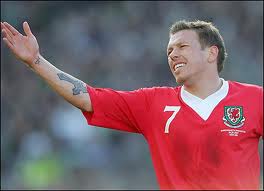
On 13 June 1979, future Wales captain and famously volatile striker Craig Bellamy was born in Cardiff. He has spent the majority of his career in England, with brief loan spells in Scotland and Wales.

Bellamy began his professional career in 1996 with Norwich City and established himself as a regular first-teamer by his second season. But after 32 goals in 84 league appearances, he drew substantial interest from other clubs, eventually moving to Coventry City in 2000 for a transfer fee of £6.5 million. Then, when Coventry were relegated at the end of his first season there, he moved on Newcastle.

He did well on the pitch at Newcastle, scoring 14 times in his first season, but he fell out with members of the coaching staff and several players, including his strike partner Alan Shearer. Manager Graeme Souness sent him out to Celtic on loan for the second half of the 2004-05 season. Afterward, he spent time with Blackburn Rovers (2005-06), Liverpool (2006-07), West Ham (2007-09), and Manchester City (2009-10) before moving to Cardiff City on loan in August 2010.

Along the way, Bellamy was accused of assault in four separate instances, though never convicted. Most recently, he was arrested in Cardiff in January 2011 for an alleged assault on two men.

Bellamy debuted for Wales in 1998 and rose to captain the team in 2006. To date, he has made 62 national team appearances and has scored 18 goals to place fifth on the list of the Wales national team's top scorers.

Thursday, June 9, 2011

10 June 1976 - The Behavior Was Bad, But Those Kits Were Worse

On 10 June 1976, UEFA banned Wales from participating in the European Championships because of crowd violence during a qualifier against Yugoslavia at Ninian Park. Initially intended to last until 1982, the ban was softened later that year.

Wales and Yugoslavia had met at Ninian Park on 22 May to play the second leg of their qualification match for that year's European Championship, with a spot in the tournament semifinals at stake. Yugoslavia had won the first leg 2-0, so the pressure was on Wales to overturn the deficit. Unfortunately for the hosts, referee Rudi Glöckner awarded a penalty to Yugoslavia in the 19th minute (replays suggested that the Yugoslavian player had dived). Josip Katalinksi duly converted the spot-kick, giving Wales an even greater mountain to climb.

A ray of hope arrived in the form of Welsh defender Ian Evans, who found a 38th-minute equalizer. Then, shortly after the break, John Toshack put the ball in the net with an acrobatic overhead kick. Glöckner, however, ruled that Toshack's play was dangerous and disallowed the goal, sending the 30,000 home supporters into a frenzy. They threw beer bottles at the referee and several fans tried to scale the fencing surrounding the pitch.

The situation grew worse for Wales. Glöckner disallowed another Toshack goal as offside, then Terry Yorath missed a penalty kick. The match ended 1-1, sending Yugoslavia through with an aggregate score of 3-1. At the final whistle, Glöckner needed an escort of 16 policemen to get off the pitch, while one spectator hurled a corner flag that stabbed an officer in the neck.

Four months after issuing the ban, UEFA lifted it to allow Wales' participation in the 1980 European Championship, but directed that no matches could be played at Ninian Park.

Sunday, February 6, 2011

7 February 1891 - The Wins Were Few And Far Between

On 7 February 1891, Ireland beat Wales 7-2 to record only their second-ever victory--almost four years after the first one.

The Irish FA was founded in 1880 and fielded their first side in 1882, making them the fourth country to produce a national team (after England, Scotland, and Wales). That first match did not augur good things, however, as Ireland were on the wrong end of a 13-0 pounding by England. They finally got their very first victory in March 1887, beating Wales 4-1.

By 1891, Ireland had returned to form, losing 11 consecutive matches (including a crushing 11-0 defeat to Wales in 1888). The last two defeats in that run of futility came in the 1891 British Home Championship, where the Irish lost a close 2-1 decision to Scotland, then fell to England 6-1. So there was little reason for optimism other than the fact that Wales had performed almost as poorly, suffering their own losses to Scotland (4-3) and England (6-1).

On the day, however, Ireland overwhelmed the visiting Welsh team with a four goals from forward Olphie Stanfield en route to a dominant 7-2 victory. The Irish team that day included Ulster half-back Jack Reynolds (pictured), whose play attracted the attention of West Brom. After moving to the Hawthorns later that year, Reynolds revealed that he had been born in England. He subsequently switched to the English national team and remains the only person to play for both nations.

Sunday, November 14, 2010

15 November 1950 - Age Is Just A Number (And In This Case, That Number Is 38)

On 15 November 1950, Arsenal defender Leslie Compton received his first cap for England. He was 38 years and 64 days old at the time, making him the oldest debutant for England since WWII and their oldest outfield player ever to make his first appearance.

Compton--who was also a noted cricketer--had played for Arsenal since 1930, helping them win the league trophy in 1948 and the 1950 FA Cup. In the Gunners' FA Cup semifinal match against Chelsea that year, Compton scored a last-minute equalizer from a cross delivered by his brother to force a replay, which Arsenal won 1-0 before beating Liverpool in the Final.

His outstanding play that season led to his call-up for England's British Home Championship match against Wales that November, one of three players to make their England debut that day (the others were Lionel Smith and Leslie Medley). Played before a crowd of 59,137 at Sunderland's Roker Park, England went up 2-0 at the half before finishing the match 4-2.

Compton played only once more for England (a 2-2 draw with Yugoslavia at Highbury on 22 November 1950) before his retirement in 1952 . He died in 1984 at the age of 72 from complications related to diabetes.

England's oldest-ever debutant was Crystal Palace goalkeeper Alexander Morten, who was 41 years, 114 days when he played against Scotland in 1873.

Thursday, October 14, 2010

15 October 1949 - The World Cup Comes To Wales

On 15 October 1949, England and Wales met in the first World Cup qualifier for both teams, with England winning 1-4.

The English and Welsh football associations had joined FIFA in 1906, but left in 1929, along with the other British associations, over a dispute about payment of amateur players. The rift prevented all of British teams from participating in the first three World Cups. The British rejoined FIFA in 1946. Rather than have them go through a separate qualification process, FIFA used the pre-existing British Home Championship as a qualification group, with the top two finishers advancing to the World Cup.

The teams met at Ninian Park in Cardiff, with England taking an early lead with a 22nd-minute goal from Blackpool's star forward, Stan Mortensen--the first England goal in a World Cup campaign. His fellow forward, Newcastle's Jackie Milburn (pictured) then added a hat-trick (29', 34', 66') before Wales eventually got on the board with a late consolation goal from right winger Mal Griffiths.

England and Scotland finished first and second in the table to progress to the World Cup, but Scotland withdrew because the head of the Scottish FA, George Graham, felt they should participate only if they won the BHC. England participated and were famously defeated by the United States.

Friday, April 16, 2010

17 April 1937 - A Guinness Type Of Day (And A World Record Day, Too)

On 17 April 1937, Scotland hosted England at Glasgow's Hampden Park for the last match of the 1937 British Home Championship. The official attendance at the match was 149,415, which set a world record at the time and remains a record for European competition.

The two sides were competing for second place, as Wales had already secured the title by winning all three of its matches. Scotland and England, meanwhile, had identical records - both had 2-1 losses to Wales and 3-1 wins over Ireland. On the day, Scottish striker Bob McPhail (pictured) provided the decisive edge, scored 2 goals in the Scots' 3-1 win over the English.

The true attendance figure for the day is unknown, as a large number of people reportedly entered the stadium without paying. But the official recorded attendance of 149,415 was, at the time, the largest football crowd in world history. That number was subsequently surpassed on the last day of the 1950 World Cup, when Uruguay upset Brazil 2-1 at the Maracaña in Rio de Janeiro. FIFA recorded the official attendance for that match as 173,850, but, like the previous record, it does not include a large number of attendees who entered the stadium illegally.

The 1937 figure, however, remains the highest recorded attendance for a European match.

Saturday, March 27, 2010

28 March 1903 - Ireland's Good Old Goodall

On 28 March 1903, center-half Archie Goodall (pictured) scored the opening goal in Ireland's 2-0 victory over Wales in the 1903 British Home Championship. Goodall was 38 years and 283 days old, making him the oldest goalscorer in the history of the Irish national team.

Born in Belfast in 1864, Goodall spent his entire club career in England, starting with Preston North End in 1887. After one season in Deepdale and one with Aston Villa, he settled with Derby County for whom he made 380 league appearances (and scored 48 goals) between 1889 and 1903.

He received his first call up for Ireland in March 1899. Prior to that time, the Irish FA had refused to allow the national team to select footballers who were playing in clubs outside Ireland, making Goodall one of the first players based in England to don a shirt for the Irish national team.

Ireland's match against Wales on 28 March 1903 was their last of the tournament. Goodall's goal - the second and last of his international career - helped the Irish finish level on points with England and Scotland and, because there was no provision in the tournament rules to break a tie, the three sides shared the trophy equally. It was the first top finish for Ireland, who would finish as runners-up the following season, then win the title outright in 1914.

Goodall left Derby County in 1903 and spent a season with Plymouth Argyle before moving to Glossop North End as player-manager. After one season there, he moved to Wolverhampton in 1905, but made only seven appearances for Wolves before retiring later that year.

Monday, March 1, 2010

2 March 1991 - Giggs' Proverbial First Step In His Record-Long Journey

On 2 March 1991, 17-year old midfielder Ryan Giggs made his first appearance for Manchester United in a 2-0 home league loss to Everton. Although he played in only one other match that season, the young Welsh left winger would later become United's appearances leader on his way to becoming the most decorated player in English football history.

Born in Cardiff, Wales, Giggs moved with his family to Salford, Greater Manchester, in 1980. He started his career as a youth player with Manchester City in 1985 before moving to United's youth program in 1987. He turned professional on his 17th birthday, 29 November 1990. For his first appearance against Everton, Giggs came on as a substitute, replacing fullback Denis Irwin. His other appearance that season was a 1-0 over Manchester City on 4 May, in which Giggs started and scored the matchwinner - his first goal for United.

He became a regular starter in the 1991-92 season, helping lead the club to a second-place League finish and the League Cup title, his first piece of silverware. Since then, he has added 11 League titles, four FA Cup trophies, two more League Cup trophies, seven Community Shields, and two UEFA Champions League trophies to his silverware cabinet, as well as one Super Cup title, one Intercontinental Cup trophy, and one Club World Cup trophy.

In 2008, Giggs memorably broke Bobby Charlton's previous record of 758 Manchester United appearances by coming on as an 87th-minute substitute in the Champions League Final against Chelsea and scoring the winning goal in the penalty shootout. Giggs is still playing for United and has made more than 820 total appearances.


Friday, February 19, 2010

20 February 1897 - It Took A While, But It Eventually Caught On

On 20 February 1897, Ireland made history by becoming the first national team in modern history to compete under the guidance of an official coach, as Billy Crone (right) took charge for their opening match against England in that year's British Home Championship. Unfortunately for the Irish, it didn't help, and England defeated them 6-0.

Prior to Crone's appointment, national team players were selected by their respective football associations, then coached by the team captain. Before overseeing the national team, Crone - himself a former Irish international with 12 caps - had established himself as the manager of his hometown club, Belfast's Distillery FC, where he played his club ball until his retirement as a player in 1893. He remained the manager of Distillery (now known as Lisburn Distillery) during and after his time in charge of Ireland, leading them to five Irish League titles between 1895 and 1906.

For the remainder of the tournament, Ireland won their next match against Wales, 4-3, but lost their final match against Scotland, 5-1, to finish third out of the four teams.

In hiring Crone, Ireland were well ahead of their competition. For comparison, England hired their first manager in 1946, while Wales and Scotland hired their first managers in 1954.

Saturday, October 3, 2009

4 October 1933 - Busby's Brief International Career

On 4 October 1933, wing half Matt Busby debuted for Scotland in a 3-2 loss to Wales at Ninian Park in the British Home Championship. He played for Scotland seven more times during World War II, but the 1933 appearance was his only official one for the Scottish national side.

Busby was in the midst of an impressive playing career for Manchester City, for whom he made a total of 229 appearances between 1928 and 1936, scoring 14 goals and winning the 1935 FA Cup. (The photo to the right shows Busby meeting the future King George VI at the 1933 FA Cup Final.)

In 1936, he transferred to Liverpool, where he played until 1939, making 122 appearances. His playing career officially ended with the outbreak of World War II as he, along with many other Liverpool players, signed up for military service with the King's Liverpool Regiment.

Wales went on to win the 1933-34 British Home Championship with a 2-1 win over England and a 1-1 draw with Ireland. Scotland finished at the bottom of the table, losing all three of their matches.

After the war, Busby started a successful management career with Manchester United, where he stayed from 1945 to 1969, and then from 1970-71. He also briefly managed a unified British national side in 1948 and the Scottish national team in 1958.

Wednesday, September 9, 2009

10 September 1985 - The Passing Of A Legend

On 10 September 1985, Scottish national team manager John "Jock" Stein died at the age of 62 after suffering a heart attack at the end of Scotland's 1-1 draw with Wales in a World Cup qualifier at Ninian Park in Cardiff. He died a short time later in the stadium's medical room.

Born in the Scottish lowlands mining town of Burnbank, South Lanarkshire on 5 October 1922, Stein signed his first professional contract as a center-half for Albion Rovers in 1942 while working part time as a coal miner. He made 200 league appearances for Albion from 1942 to 1950, then spent the 1950-51 season with Welsh side Llanelli Town before moving to Celtic in 1951. He made 148 league appearances for Celtic before ankle injuries forced him to retire in 1956.

Upon retirement as a player, Stein moved into management, starting with the Celtic reserve side. In 1960, he took over as manager of Dunfermline Athletic and led them to their first Scottish Cup victory in 1961 with a 2-0 victory over Celtic in the Final replay. He left Dunfermline in 1964 and spent the 1964-65 season in charge of Hibernian before returning to Celtic in 1965. He also managed the Scottish national side part-time in 1965.

Stein enjoyed his greatest success at Celtic, winning ten league titles, eight Scottish Cups, and six Scottish League Cups between 1965 and 1978. His crowning acheivement, however, was beating Inter Milan in the 1967 European Cup Final, thus becoming the first man to win the prestigious trophy with a British club.

Despite his successes, he was pressured out from Celtic in 1978 in favor of new manager Billy McNeill. Stein accepted the managerial position at Leeds United later that year, but left after only 45 days in order to manage the Scottish national side full time.

After his death, Stein was posthumously inducted into the Scottish Sports Hall of Fame and the Scottish Football Hall of Fame. Since the 1990s, the west end of Celtic Park has been named the Jock Stein Stand and a bust of Stein is located in the stadium's foyer.

Friday, June 19, 2009

19 June 1958 - The Kid Is Alright

On 19 June 1958, Brazil defeated Wales 1-0 in a World Cup quarterfinal match before a crowd of 25,000 at Råsunda Stadium in Stockholm, Sweden.

The Brazilian team was eager to prove itself after an early exit in the previous World Cup. Several new players had been added, as well as a new manager, Vicente Feola. They had finished at the top of their group in the first round without conceding a goal, including wins over Austria (3-0) and the Soviet Union (2-0), and a 0-0 draw with England.

The Welsh side, on the other hand, had advanced to the quarterfinals without a win. They drew with Hungary (1-1), Mexico (1-1), and Sweden (0-0) to finish second in their group.

In the first half, both sides played defensively and neither was able to score. That changed in the 66th minute. Brazil's central midfielder Didi headed the ball into the Welsh penalty area, where it was collected by the youngest player in the tournament--Edison Arantes do Nascimento, nicknamed Pelé, a 17-year, 239-day old Brazilian midfielder who was playing in only his second World Cup match. Pelé chested the ball down and deftly passed it around the Welsh defender before slotting it into the bottom corner of the goal. It was Pelé's first World Cup goal and the only goal of the match, giving Brazil the win.

Brazil advanced and eventually won the tournament, beating Sweden 5-2 in the Final. Pelé scored five more goals in the tournament, including two in the Final against Sweden. He went on to become the all-time leading scorer for the Brazilian national team with 77 goals in 92 appearances and led them to two more World Cup titles in 1962 and 1970.

Monday, June 15, 2009

16 June 1927 - The Real Hebrew Hammer

On 16 June 1927, Yaakov Hodorov was born in Rishon LeZion, Palestine. Remembered as one of the best goalkeepers of his generation, he played for the Israeli national team from 1949 to 1964.

Hodorov began his professional career in 1942 at the age of 15 with his hometown club Maccabi Rishon LeZion, but moved after a couple of years to local rival Hapoel Rishon LeZion. In 1947, he moved again, this time to Hapoel Tel Aviv, where he spent the majority of his club career and won his first major honors - the Israeli league championship in 1957 and the Israeli cup in 1960.

One of Hodorov's most memorable matches was a World Cup qualifier against Wales on 5 February 1958. At the time, Israel was playing in the Asian Football Confederation and almost qualified for the 1958 World Cup without playing a match. Israel's first scheduled opponent was Turkey, who refused to compete in the Asian group, allowing Israel to advance. Israel's opponent in the second round, Indonesia, withdrew from qualification after FIFA rejected their request to play Israel on neutral ground. Israel was then scheduled to play Sudan in the third round, but the Sudanese refused to play.

Israel would have qualified automatically, but FIFA ruled that, apart from the hosts and the defending champions, no team could qualify without playing a match and thus drew Wales for a special playoff against Israel. After Wales won the first leg 2-0 in Israel, the teams met in Cardiff on 5 February 1958. Wales again won 2-0, but Hodorov drew high praise for making several outstanding saves and playing after suffering a broken nose in a collision with Welsh striker John Charles.

Hadorov reportedly received numerous offers to play for European clubs including Arsenal, Dundee United, and Fenerbahçe, but chose to play his entire career in Israel.

In 2006, the Israeli government awarded him the Israel Prize for excellence and contribution to sports. He had a stroke shortly before the presentation ceremony, however, and was unable to attend. He died on 31 December 2006 at the age of 79.

Wednesday, March 25, 2009

25 March 1876 - Scottish Footballers Give Bad Birthday Presents

On 25 March 1876, Wales played its first competitive football match, against Scotland in Glasgow. Scotland won the match 4-0, with goals from John Ferguson, James Lang, Billy MacKinnon, and Henry McNeil.

With that match, the Welsh team, nicknamed the Dragons, became the third oldest international football team, after England and Scotland. Though it is part of the United Kingdom, Wales has continued to field its own independent football team for all competitions except the Olympics, which recognizes only a unified UK team.

Wales has qualified for the World Cup only once, in 1958, when it finished second in its qualifying group among Hungary, Mexico, and host nation Sweden. Wales was eliminated in the first knockout round by Brazil, when Pele scored the only goal of the match in the 66th minute. Brazil went on to win the tournament, claiming their first World Cup title.